
Refrigerated Dryer


Overview Yipu Water-Cooled Refrigerated Air Dryer leverages high-efficiency water-cooled heat exchange technology to deliver three core customer values: providing stable and reliable dry air solutions for high-temperature environments and large-capacity scenarios, reducing customers’ total lifecycle costs through energy efficiency optimization, and saving valuable space in modern workshops with its compact design. This product is particularly…
Overview
Yipu Water-Cooled Refrigerated Air Dryer leverages high-efficiency water-cooled heat exchange technology to deliver three core customer values: providing stable and reliable dry air solutions for high-temperature environments and large-capacity scenarios, reducing customers’ total lifecycle costs through energy efficiency optimization, and saving valuable space in modern workshops with its compact design. This product is particularly suitable for large manufacturing enterprises with centralized air supply systems, special industries with harsh environmental conditions, and technical renovation projects sensitive to energy consumption indicators.
I. Market Pain Point Analysis
- Poor Adaptability to High-Temperature EnvironmentsAir-cooled refrigerated air dryers experience a sharp drop in efficiency when ambient temperature exceeds 38℃. Heat dissipation is challenging in high-temperature workshops and closed machine rooms, affecting drying performance.
- Heat Dissipation Requirements for Large-Scale SystemsAir-cooled equipment becomes bulky when processing capacity exceeds 100 Nm³/min. High-power fans cause severe noise pollution (typically >75 dB).
- Space Layout RestrictionsAir-cooled equipment requires sufficient ventilation clearance, occupying valuable workshop space. Thermal recirculation easily occurs when multiple units are arranged in parallel, reducing operational efficiency.
- Demand for Energy Efficiency OptimizationCentralized air supply systems in large air compressor stations can fully utilize existing circulating water systems. Water-cooled heat exchange is 30-40% more efficient than air-cooled, facilitating energy conservation and consumption reduction.
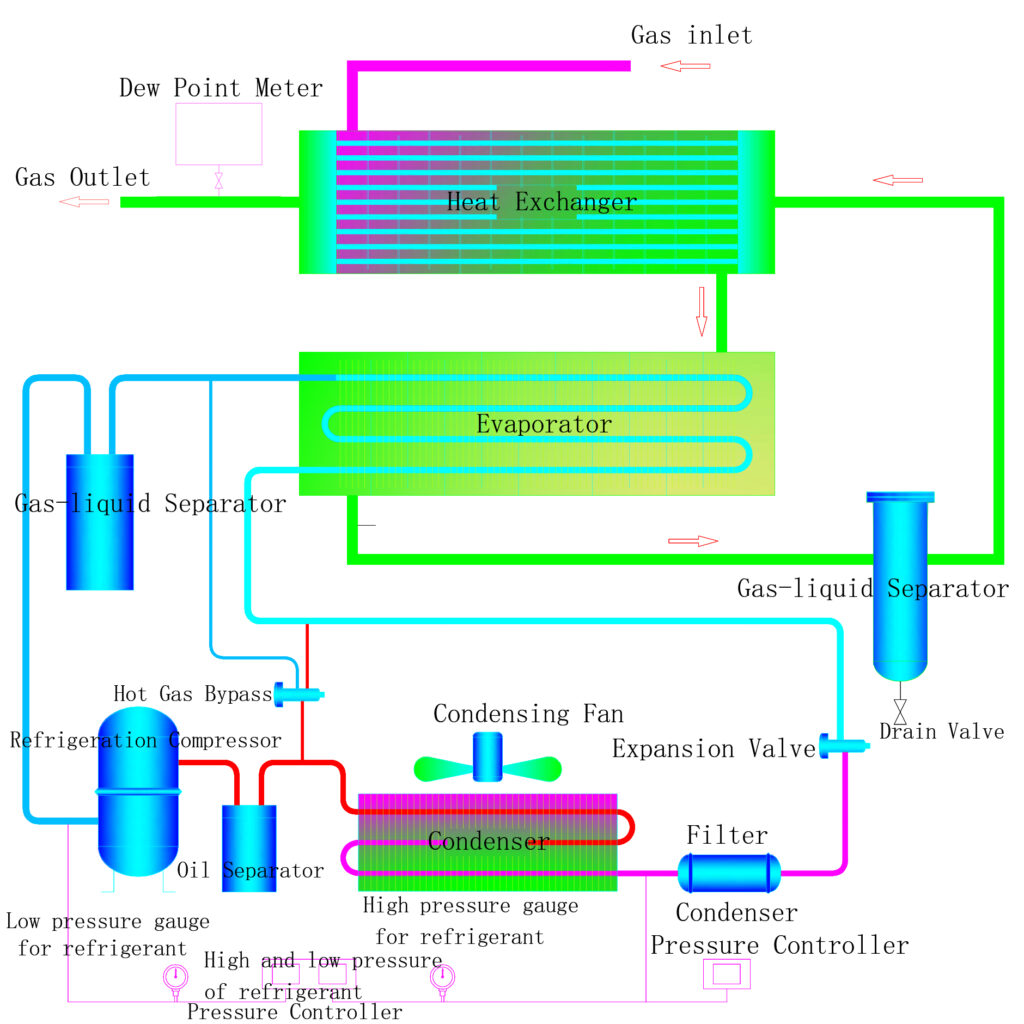
II. System Process Flow
Four-Stage Cooling System:
- First-Stage Pre-Cooling SectionInlet air exchanges heat with outlet cold air through an air-to-air heat exchanger, reducing temperature from 80℃ to 45℃ and recovering 25-30% of cooling capacity.
- Second-Stage Water-Cooling SectionCooling water (20-32℃) cools the refrigerant through a shell-and-tube heat exchanger, increasing refrigerant condensation efficiency by over 35% compared to air-cooled systems.
- Third-Stage Deep RefrigerationThe refrigerant undergoes heat and mass transfer with air in the evaporator, lowering the air temperature to a pressure dew point of 2-10℃.
- Fourth-Stage Gas-Water SeparationTwo-stage dehydration (cyclone separation + coalescing filtration) achieves a liquid water removal rate of >97%.
Water Circulation System:
- Adopts closed-loop design with water filter and flow switch.
- Automatic water temperature control valve precisely maintains the optimal operating temperature.
- Optional plate heat exchanger for secondary heat recovery.
III. In-Depth Technical Principle Analysis
High-Efficiency Heat Exchange Mechanism:
- Evaporator features inner-threaded tubes + aluminum fins, with a heat transfer coefficient of 45 W/m²·K.
- Shell-and-tube condenser has a 20% larger heat exchange area than standard models.
Precision Temperature Control System:
- Three-way control valve automatically adjusts water flow based on condensation pressure, maintaining the condensation temperature within the optimal range of 35±2℃.
Intelligent Drainage Solution:
- Dual drainage system (float-type + electronic-type) automatically adjusts drainage frequency according to condensation volume.
IV. Core Competitive Advantages
- Outstanding Energy Efficiency
- 18-25% more energy-efficient than air-cooled models of the same specification.
- EER value reaches 3.2-3.8 (typically 2.6-3.0 for air-cooled models).
- Strong Environmental Adaptability
- Operates at full load in high-temperature environments up to 45℃.
- Reduces requirements for machine room ventilation by 80%.
- Optimized Space Utilization
- 25-30% smaller in volume than air-cooled models with the same processing capacity.
- Supports wall-mounted installation, saving valuable workshop space.
- High Operational Reliability
- Core components have a design lifespan of ≥10 years.
- Automatic anti-freeze protection prevents damage under low-temperature conditions.
V. Technical Strength
Innovative Technology Application:
- Intelligent throttling control based on working condition adaptation.
- Condenser heat recovery technology (optional).
- Predictive maintenance algorithm.
Manufacturing Process Advantages:
- Evaporator tube wall thickness ≥0.8mm, pressure resistance of 2.5MPa.
- Overall pressure retention and leak detection standard: ≤0.03MPa/year.
- Water system pressure test: 1.6MPa.
VI. Product Series Introduction
Standard Series:
- YC-10~100: Processing capacity 13.5-102 Nm³/min
- YC-120~300: Processing capacity 120-306 Nm³/min
- YC-350~510: Processing capacity 336-510 Nm³/min
Special Series:
- High-Temperature Type (inlet air temperature ≤80℃)
- Explosion-Proof Type (Ex d Ⅱ CT4)
- Dual-Compressor Redundant Type
VII. Application Scenario Solutions
Heavy Industry Scenarios:
- Iron and Steel Metallurgy: Centralized air supply drying for air compressor stations.
- Shipbuilding Welding: Large-flow stable air supply.
Special Environments:
- Closed Machine Rooms: Submarines, underground projects.
- High-Temperature Workshops: Foundries, heat treatment workshops.
Energy-Saving Renovation:
- Conversion of existing air-cooled systems to water-cooled.
- Waste heat recovery and comprehensive utilization projects.
VIII. Detailed Technical Specifications
| Parameter Category | Technical Indicators | Remarks |
|---|---|---|
| Basic Parameters | ||
| Air Processing Capacity | 13.5-510 Nm³/min | Customizable according to requirements |
| Working Pressure | 0.6-1.0 MPa | Adaptable to different pressure requirements |
| Pressure Dew Point | 2-10℃ | Stable and reliable |
| Pressure Loss | ≤3% of inlet pressure | Energy-saving and efficient |
| Working Condition Parameters | ||
| Inlet Air Temperature | Normal-Temperature Type <45℃ / High-Temperature Type ≤80℃ | Two models available |
| Cooling Method | Water-Cooled | High heat exchange efficiency |
| Water System Parameters | ||
| Cooling Water Inlet Temperature | <38℃ | Standard industrial requirement |
| Cooling Water Inlet Pressure | 0.2-0.4 MPa | Stable water supply pressure |
| Cooling Water Quality | Industrial Circulating Water | Economical and practical |
| Water Consumption | 2-85 T/h | Determined by model |
| Electrical Parameters | ||
| Voltage | 220-380V | Wide voltage adaptation |
| Compressor Power | 3-120 Hp | Multiple power options available |
| Structural Parameters | ||
| Air Inlet/Outlet Diameter | DN65-DN300 | Standard flange connection |
| Equipment Weight | 220-6000 kg | Determined by model |
| Overall Dimensions (L×W×H) | (1140-4800)×(690-2200)×(1105-2850) mm | Compact design |