
Air-Cooled Refrigerated Dryer

Overview Through innovative design and manufacturing processes, Yipu Air-Cooled Refrigerated Air Dryer delivers three core values to users: This product is particularly suitable for small and medium-sized manufacturing enterprises, water-scarce areas, and locations with limited installation space, serving as a cost-effective compressed air drying solution. I. Market Pain Point Analysis II. System Process Flow Four-Stage…
Overview
Through innovative design and manufacturing processes, Yipu Air-Cooled Refrigerated Air Dryer delivers three core values to users:
- Significant Economic Benefits: No need for cooling water, resulting in low operating costs; high-efficiency and energy-saving design reduces energy consumption further.
- Easy Usage: Simple installation without complex water piping systems; convenient maintenance lowers operation and maintenance costs.
- Reliable and Durable: High-quality components ensure a long service life; strong adaptability enables stable operation in various environments.
This product is particularly suitable for small and medium-sized manufacturing enterprises, water-scarce areas, and locations with limited installation space, serving as a cost-effective compressed air drying solution.
I. Market Pain Point Analysis
- Equipment Failures Caused by Moisture in Compressed Air
- Moisture leads to rust and jamming of pneumatic tools, cylinders, solenoid valves, and other equipment.
- Quality defects such as watermarks and spots on surfaces in spraying and painting processes.
- Low Energy Efficiency of Traditional Drying Equipment
- Some old refrigerated dryers have high energy consumption and large operating costs.
- Water-cooled equipment requires a continuous supply of cooling water, resulting in high water resource consumption.
- Installation Environment Restrictions
- Large water-cooled equipment cannot be installed in space-constrained areas.
- Usage is limited in regions lacking cooling water sources.
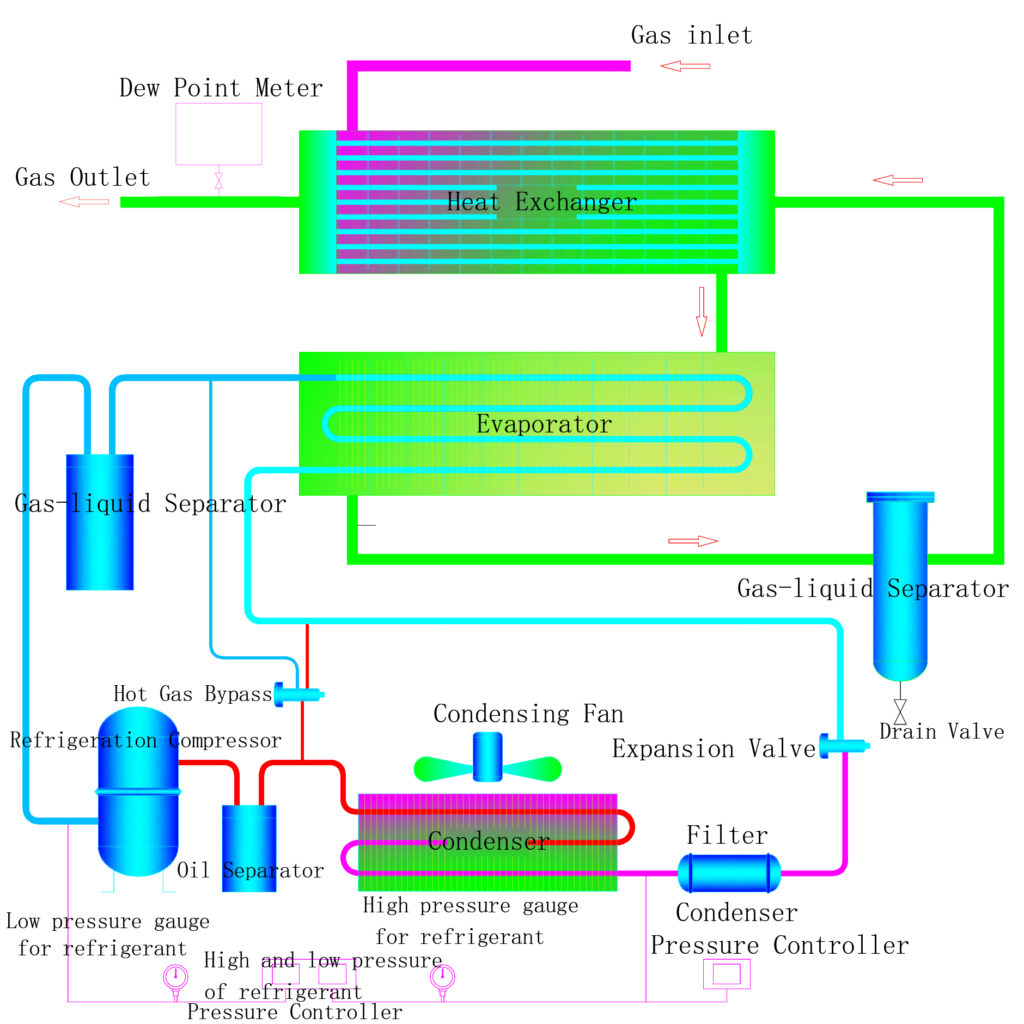
II. System Process Flow
Four-Stage Cooling and Drying System:
- First-Stage Heat Exchange Pre-Cooling
- High-temperature compressed air enters the air-to-air heat exchanger.
- Initial heat exchange with outlet cold air significantly reduces the temperature.
- Second-Stage Evaporator Deep Cooling
- Pre-cooled air enters the evaporator for heat exchange with the refrigerant.
- The temperature is lowered to a pressure dew point of 2-10℃, and a large amount of moisture condenses.
- Third-Stage Gas-Water Separation
- Utilizes cyclone separation and filter coalescence technology.
- Efficiently separates condensed moisture and oil.
- Fourth-Stage Temperature Recovery Output
- Dry cold air returns to the heat exchanger for reheating.
- Prevents condensation on the outer wall of the outlet pipeline and improves system energy efficiency.
III. Technical Principle
Refrigeration Cycle System:
- Adopts a high-efficiency refrigeration compressor, with refrigerant circulating in the system.
- The refrigerant evaporates and absorbs heat in the evaporator, lowering the air temperature below the dew point.
- The condenser achieves heat exchange through forced heat dissipation by an axial flow fan.
Heat Recovery Technology:
- Innovative air-to-air heat exchange design.
- Uses the cold energy of the outlet cold air to pre-cool the incoming hot air.
- Significantly reduces the load on the refrigeration system, achieving obvious energy-saving effects.
IV. Core Competitive Advantages
- High-Efficiency and Energy-Saving Design
- Adopts high-efficiency heat exchangers and optimized flow channel design.
- Heat recovery system achieves 15-20% energy savings.
- Wide Temperature Range Adaptability
- Normal-temperature type (≤45℃) and high-temperature type (≤80℃) available.
- Adapts to different working condition requirements.
- Intelligent Control System
- Automatic temperature control and pressure protection.
- Fault self-diagnosis and alarm functions.
- Low Maintenance Costs
- Air-cooled design eliminates the need for water treatment systems.
- Modular design facilitates maintenance and upkeep.
V. Technical Strength
Core Technical Advantages:
- Design and manufacturing technology of high-efficiency finned heat exchangers.
- Precision matching and optimization technology of refrigeration systems.
- R&D and integration capabilities of intelligent control systems.
Manufacturing Process Guarantee:
- Strict tightness testing of refrigeration systems.
- Overall performance testing and reliability verification.
- Standardized production lines and quality management systems.
VI. Product Series Introduction
Small Series (1.2-10 Nm³/min):
- Suitable for laboratories and small workshops.
- Compressor power: 1/3-3 Hp
- Weight: 60-200 kg
Medium Series (12-40 Nm³/min):
- Suitable for medium-sized manufacturing enterprises.
- Compressor power: 5-10 Hp
- Weight: 250-800 kg
Large Series (45-85 Nm³/min):
- Suitable for large factories.
- Compressor power: 15-20 Hp
- Weight: 900-1600 kg
VII. Application Scenarios
Manufacturing Sector:
- Automotive Manufacturing: Spraying robots, assembly lines.
- Electronic Manufacturing: SMT equipment, testing instruments.
- Machining: CNC machine tools, pneumatic fixtures.
Food and Pharmaceutical Industry:
- Food packaging and filling equipment, pharmaceutical equipment air supply, cleanroom process air.
Special Environment Applications:
- Water-scarce areas, mobile air compressor stations, high-temperature environment workshops.
VIII. Detailed Technical Specifications
Yipu Air-Cooled Refrigerated Air Dryer Technical Parameter Sheet
| Parameter Category | Technical Specifications | Remarks |
|---|---|---|
| Operating Conditions | ||
| Inlet Air Temperature | Normal-temperature type ≤45℃, High-temperature type ≤80℃ | Two models available |
| Cooling Method | Air-Cooled | No cooling water required |
| Working Pressure | 0.6~1.0 MPa | Standard working range |
| Ambient Temperature | ≤38℃ | Maximum ambient temperature |
| Performance Indicators | ||
| Pressure Dew Point | 2~10℃ | Dew point of dried air |
| Pressure Loss | ≤3% of inlet pressure | System pressure loss |
| Air Processing Capacity | 1.2~85 Nm³/min | Standard condition flow rate |
| Electrical Parameters | ||
| Power Supply Voltage | 220V/380V/50HZ | Two voltage options available |
| Compressor Power | 1/3~20 Hp | Determined by model |
| Fan Power | 180W~300W×8 | Multi-fan configuration |
| Structural Parameters | ||
| Air Inlet/Outlet Diameter | Rc1″~DN125 | Multiple interface specifications available |
| Equipment Weight | 60~1600 kg | Determined by model |
| Overall Dimensions (L×W×H) | (700-2860)×(450-1860)×(945-2850) mm | Compact design |