
Instrument Air Nitrogen Generator


Yipu Instrument Air Nitrogen Generator is an on-site nitrogen production solution that cleverly leverages existing factory resources, combining economy and reliability. By directly connecting to the instrument air system, it eliminates the need for a large air compression unit. With its efficient PSA process, intelligent control system, and long-term protection of core components, it provides…
Yipu Instrument Air Nitrogen Generator is an on-site nitrogen production solution that cleverly leverages existing factory resources, combining economy and reliability. By directly connecting to the instrument air system, it eliminates the need for a large air compression unit. With its efficient PSA process, intelligent control system, and long-term protection of core components, it provides users with a nitrogen supply option featuring lower investment, faster installation, and hassle-free operation. It is an ideal equipment for function extension and upgrading of instrument air systems in modern process industries.
I. Market Pain Points
- Reliance on Instrument Air System Stability: In industries such as petroleum, chemical, and power, the stability of the instrument air (compressed air for factory instruments) system is crucial. Any moisture, oil, or pressure fluctuations may cause malfunctions of precision instruments and control valves, leading to production accidents.
- High Cost of Dedicated High-Purity Gas Source: For protecting instruments or process purging, purchasing high-purity nitrogen separately incurs extremely high costs and carries the risk of supply interruption.
- Space Constraints and Installation Convenience Requirements: In existing factories or compact skid-mounted modules, equipment needs to be compact in structure, quick to install, and require no complex civil engineering foundations.
- Unattended Operation and Remote Monitoring: Modern factories require auxiliary equipment to operate fully automatically, integrate into the central control room, and achieve remote monitoring and fault early warning to reduce operational and maintenance labor costs.
- Adaptability to Gas Source Quality Fluctuations: Directly using factory instrument air as raw material requires the nitrogen generator to adapt to certain fluctuations in pressure and flow rate of the front-end compressed air while still producing nitrogen of stable purity.
II. System Process
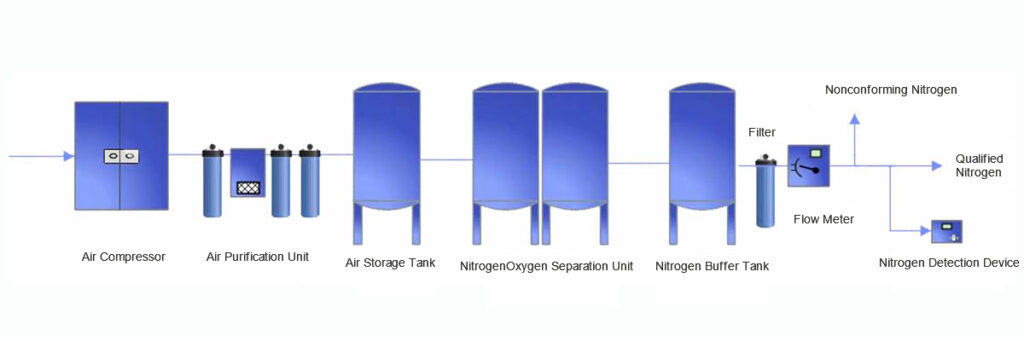
Yipu Instrument Air Nitrogen Generator directly utilizes the factory’s existing instrument compressed air system, featuring an efficient and concise process:
- Raw Gas Connection: Directly connects to the factory’s pre-treated instrument air (operating pressure: 0.1~8.0Mpa). This eliminates the need for an independent air compressor system, reducing initial investment and floor space.
- Deep Purification Treatment (Key Step): Although instrument air is initially dried, to ensure the long service life of carbon molecular sieves (CMS) and nitrogen purity, the air first enters a built-in high-efficiency filter and precision drying module (possibly integrated with adsorbents) to further remove trace oil, moisture, and particulates, ensuring the air entering the adsorption tower is ultra-clean and dry.
- PSA Adsorption Nitrogen Production:
- Adsorption & Nitrogen Production: Clean and dry instrument air enters Adsorption Tower A. The CMS inside the tower preferentially adsorbs oxygen, carbon dioxide, and residual moisture. Enriched nitrogen is output from the top of the tower.
- Regeneration & Desorption: Meanwhile, Tower B is depressurized to atmospheric pressure, allowing adsorbed impurities such as oxygen to desorb and be exhausted as waste gas, realizing CMS regeneration.
- Pressure Equalization & Switching: At the end of Tower A’s adsorption cycle and after Tower B’s regeneration is completed, pressure equalization is performed between the two towers to recover energy and nitrogen, improving efficiency. The valves then switch automatically, and the roles of the two towers are swapped to achieve continuous production.
- Nitrogen Buffering & Quality Assurance: Produced nitrogen enters a buffer tank to stabilize pressure. The system is equipped with an intelligent interlock device. If unqualified nitrogen purity is detected, it will automatically switch to venting mode, ensuring only qualified nitrogen is delivered to the gas consumption points.
III. Working Principle
The core working principle is based on “Pressure Swing Adsorption (PSA)” and “kinetic separation”.
- Kinetic Separation: The microporous structure of CMS acts as a sieve for gas molecules. Oxygen molecules (smaller diameter, faster diffusion) quickly diffuse into the CMS pores and are adsorbed; while most nitrogen molecules (slightly larger diameter, slower diffusion) remain in the gas phase, resulting in enriched nitrogen at the outlet.
- Pressure Swing Adsorption: Utilizes the characteristic of CMS having a large adsorption capacity under high pressure and a small adsorption capacity under low pressure. Through the cycle of pressurized adsorption and atmospheric desorption, oxygen adsorption and desorption are achieved, enabling continuous separation of nitrogen and oxygen.
IV. Core Advantages
- Plug-and-Play, Low Investment: Directly utilizes existing instrument air, eliminating the need for a complete system including air compressors, air receivers, and aftercoolers, significantly reducing initial equipment investment and floor space.
- High Efficiency & Energy Saving, Low Air Consumption: Adopts multi-stage pressure equalization technology and optimized process design, featuring low effective air consumption and high nitrogen recovery rate, ensuring economical operating costs.
- Intelligent Full-Automatic Operation, Safe & Reliable:
- PLC Control: Enables one-key start-stop, automatic switching, purity/flow rate monitoring and adjustment.
- Intelligent Interlock: Automatic venting of unqualified nitrogen ensures the safety of downstream gas usage.
- Remote Maintenance: Supports data transmission, realizing unattended operation and predictive maintenance.
- Long-Lasting and Durable Core Components:
- Unique CMS Compaction & Protection: Reasonable design of internal components ensures uniform gas flow distribution, effectively reducing impact and preventing CMS pulverization, extending the service life of core adsorbents.
- High-Quality Components: Rational configuration of system-related components ensures low failure rate and long-term stable operation.
- Skid-Mounted Integration, Easy Installation: The entire machine is tested at the factory and delivered as an integrated skid, requiring no on-site foundation installation. On-site installation only requires connecting instrument air pipelines, power supply, and nitrogen output pipelines, with an extremely short installation cycle.
V. Technical Strength
- Efficient Pretreatment Technology: Targeting instrument air sources, a built-in high-efficiency precision purification unit ensures CMS operates under optimal conditions.
- Precise Program Control Algorithm: Intelligent software enables accurate cycle switching and automatic adjustment of purity and flow rate within a certain range according to gas demand, achieving optimal operation.
- Mature Structural Design Capability: In-depth research on internal gas flow distribution of adsorption towers maximizes adsorption efficiency through reasonable structural design while protecting CMS.
- Strong Modular Customization Capabilities: Nitrogen output covers 5~1500 Nm³/h, meeting the needs of small-scale equipment to large-scale factories. It can also flexibly configure advanced functions such as remote control and automatic purity adjustment.
VI. Product Introduction
- Product Name: Yipu Instrument Air Nitrogen Generator
- Brand: Yipu
- Core Process: Pressure Swing Adsorption (PSA)
- Adsorbent: High-performance Carbon Molecular Sieve (CMS)
- Raw Gas: Factory Instrument Compressed Air
- Working Mode: Dual-tower/multi-tower alternation, continuous cyclic operation
- Control Method: PLC programmable controller, digital temperature control instrument, automatic fault alarm
VII. Application Scenarios
- Petrochemical Industry: Tank nitrogen sealing, pipeline and vessel purging, catalyst protection, reactor blanket gas.
- Natural Gas Processing: Instrument air system supplementation, equipment purging and protection in LNG plants.
- Power Industry: Transformer protection, cable nitrogen filling in thermal power plants and nuclear power plants.
- Pharmaceutical & Food Industry: Upgrading existing compressed air systems to provide nitrogen required for processes.
- General Manufacturing: Welding protection, heat treatment, and electronic product production.
VIII. Technical Specifications
| Parameter Item | Technical Indicators / Description |
|---|---|
| Product Category | Instrument Air Nitrogen Generator |
| Nitrogen Output | 5 ~ 1500 Nm³/h |
| Effective Air Consumption | 0.25 ~ 68 Nm³/min (Reflecting high efficiency and energy saving) |
| Nitrogen Purity | 95% ~ 99.999% (Adjustable according to requirements) |
| Operating Pressure | 0.1 ~ 8.0 Mpa (Matching instrument air system pressure) |
| Design Pressure | 1.0 ~ 9.0 Mpa |
| System Pressure Drop | ≤ 50 kPa |
| Noise Level | ≤ 85 dB |
| Control & Safety | PLC full-automatic control, automatic venting of unqualified nitrogen |
| Core Advantages | Plug-and-Play, High Efficiency & Energy Saving, Intelligent Automation, Stable & Reliable |