
Modular Nitrogen Generator


Yipu Combined Nitrogen Generator integrates efficient combined air purification with mature Pressure Swing Adsorption (PSA) technology to create a high-performance, cost-effective on-site nitrogen production solution. It precisely addresses core pain points of users regarding gas costs, supply stability, purity requirements, and operational convenience. Its long-service-life design, low energy consumption, and high automation level make it…
Yipu Combined Nitrogen Generator integrates efficient combined air purification with mature Pressure Swing Adsorption (PSA) technology to create a high-performance, cost-effective on-site nitrogen production solution. It precisely addresses core pain points of users regarding gas costs, supply stability, purity requirements, and operational convenience. Its long-service-life design, low energy consumption, and high automation level make it an ideal choice for replacing traditional gas supply methods and upgrading existing nitrogen generation equipment, capable of delivering sustained and stable value to a wide range of industrial users.
I. Market Pain Points
- High Cost of Purchased Gas: Long-term reliance on bottled nitrogen or liquid nitrogen not only incurs high gas costs but also involves frequent transportation, loading/unloading, and management expenses, resulting in an extremely high total cost of ownership.
- Unstable Supply and Poor Flexibility: External gas supply is susceptible to weather, traffic, supplier production conditions, and other factors, failing to ensure 24/7 on-demand supply. Production lines may shut down due to gas shortages.
- Huge Investment in Traditional Cryogenic Air Separation: For users with small to medium flow rate requirements, cryogenic air separation units feature high investment costs, large floor space, long startup times, and high operational energy consumption, lacking economic viability.
- Mismatch Between Purity and Flow Rate Requirements: Different processes have varying demands for nitrogen purity and flow rate (e.g., 99.5% for nitrogen sealing, 99.999% for electronic protection), requiring flexible and adjustable gas production equipment.
- Complex Operation & Maintenance and Reliability Concerns: Non-branded or technologically outdated nitrogen generation equipment suffers from high failure rates, severe molecular sieve pulverization, and high energy consumption. It requires dedicated personnel for maintenance, increasing hidden operational costs.
II. System Process
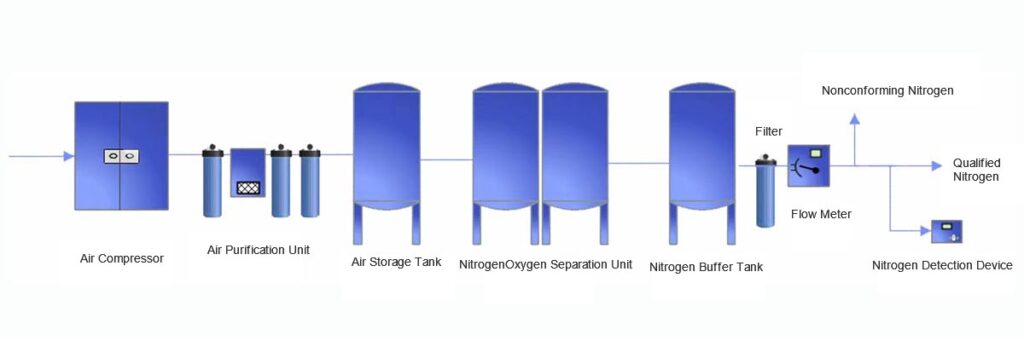
Yipu Combined Nitrogen Generator adopts a mature dual-tower Pressure Swing Adsorption (PSA) process to achieve continuous and stable nitrogen production:
- Air Compression System: Ambient air is compressed by an air compressor to the required operating pressure (0.1~8.0MPa).
- Air Purification System (Combined Core): Compressed air first enters a combined dryer, which integrates refrigerated drying and adsorption drying to deeply remove moisture, oil, and partial carbon dioxide from the air, providing ultra-clean, low-dew-point feed air. This is a key front-end combination to protect carbon molecular sieves (CMS) and ensure long-term stable operation of the system.
- Pressure Swing Adsorption Separation System:
- Tower A: Adsorption & Nitrogen Production: Clean compressed air enters Adsorption Tower A, filled with carbon molecular sieves (CMS). CMS preferentially adsorbs oxygen, carbon dioxide, and water molecules, while nitrogen is enriched in the gas phase and output as product gas.
- Tower B: Depressurization & Regeneration: Meanwhile, Tower B is depressurized to atmospheric pressure, allowing adsorbed impurities such as oxygen to desorb from the CMS and be exhausted as waste gas, achieving regeneration.
- Pressure Equalization Process: After Tower A completes adsorption and Tower B finishes regeneration, pressure equalization is performed between the two towers. This step effectively recovers pressure energy and nitrogen-rich gas in the towers, significantly improving nitrogen recovery rate and reducing energy consumption.
- Automatic Switching & Continuous Gas Supply: Controlled by PLC-operated valves, the dual towers (A and B) alternately perform the cycle of [Adsorption] → [Pressure Equalization (Depressurization)] → [Regeneration] → [Pressure Equalization (Pressurization)] → [Re-adsorption], ensuring continuous nitrogen output.
- Nitrogen Buffering & Output: Produced nitrogen enters a buffer tank to stabilize pressure before being delivered to gas consumption points. The system is equipped with an automatic unqualified nitrogen venting device to ensure only qualified product gas enters the pipeline network.
III. Working Principle
The core working principle is based on “Pressure Swing Adsorption (PSA)” and “kinetic separation effect”.
- Kinetic Separation: The interior of CMS is filled with micropores. The diffusion rate of oxygen molecules (kinetic diameter 3.46Å) is much faster than that of nitrogen molecules (kinetic diameter 3.64Å). During the pressurized adsorption stage, oxygen diffuses into the micropores of CMS more quickly and is adsorbed, while most nitrogen remains in the gas flow due to slow diffusion, resulting in enriched nitrogen at the outlet.
- Pressure Swing Adsorption: Adsorption is carried out under relatively high pressure. Regeneration is achieved by rapidly depressurizing to atmospheric pressure, allowing adsorbed oxygen molecules to desorb and restoring the activity of CMS. This cycle of “pressurized adsorption and atmospheric desorption” realizes continuous gas separation.
IV. Core Advantages
- Combined Purification, Long CMS Service Life: The core advantage lies in the front-end combined dryer, which provides far superior purification effects compared to conventional refrigerated drying. It protects expensive CMS from the source, preventing poisoning and pulverization, significantly extending service life and reducing maintenance costs.
- High Efficiency & Energy Saving, Economical Operation: Adopts multi-stage pressure equalization technology and efficient process design, featuring high nitrogen recovery rate and low effective air consumption. It is significantly more energy-saving than traditional equipment, with obvious long-term operational cost advantages.
- Intelligent Full-Automatic Operation: Equipped with PLC control, enabling one-key start-stop, full-automatic cycling, adjustable purity/flow rate, automatic fault alarm, and intelligent interlock venting. Supports remote monitoring, truly realizing unattended operation.
- Optimized Structure, Stable & Reliable:
- Rational Internal Components: Ensure uniform gas flow distribution and reduce high-speed impact on CMS.
- Unique CMS Compaction System: Prevent CMS from pulverization due to fluidization.
- High-Quality Component Configuration: Low failure rate, guaranteeing long-term stable operation of the equipment.
- Skid-Mounted Integration, Easy Installation: The entire machine is assembled and tested at the factory, delivered as an integrated skid. On-site installation only requires connecting pipelines and power supply, with no need for on-site foundation, greatly shortening the construction period.
V. Technical Strength
- Advanced Process Simulation & Design: In-depth understanding and optimized design of adsorption tower structure, pressure equalization process, and timing control, ensuring the system operates under optimal working conditions.
- Core Adsorbent Management: Proficiency in CMS selection, loading, and compaction technology, which is fundamental to ensuring equipment performance and service life.
- Intelligent Control Algorithm: Optimized PLC program can intelligently adjust cycles according to gas demand and automatically adapt within a certain range of purity and flow rate.
- Modularization & Customization Capabilities: Nitrogen output covers 5~1500 Nm³/h, and purity can be adjusted according to requirements (99%~99.999%), enabling customized solutions for customers in different industries.
VI. Product Introduction
- Product Name: Yipu Combined Pressure Swing Adsorption (PSA) Nitrogen Generator
- Brand: Yipu
- Core Process: Pressure Swing Adsorption (PSA)
- Adsorbent: High-performance Carbon Molecular Sieve (CMS)
- Front-End Purification: Combined Compressed Air Dryer (Refrigerated + Adsorption)
- Working Mode: Dual-tower/multi-tower alternation, continuous cyclic operation
- Control Method: PLC programmable controller, digital display instruments, automatic fault alarm
VII. Application Scenarios
- Chemical & Petrochemical Industry: Nitrogen sealing of pipelines and vessels, material purging, product transportation protection.
- Electronics & Semiconductor Industry: Electronic component packaging, SMT reflow soldering, protective atmosphere for LED chip production.
- Food & Pharmaceutical Industry: Nitrogen-filled food preservation, grain and oil storage, pharmaceutical packaging and production.
- Metallurgy & Heat Treatment Industry: Protective gas for bright annealing, brazing, sintering, and carburizing processes.
- Plastic & Rubber Industry: Plastic pellet transportation, tire vulcanization.
- Coal & Mining Industry: Coal mine fire prevention and extinguishing, gas dilution.
VIII. Technical Specifications
| Parameter Item | Technical Indicators / Description |
|---|---|
| Product Category | Combined Nitrogen Generator (PSA) |
| Nitrogen Output | 5 ~ 1500 Nm³/h (Customizable) |
| Effective Air Consumption | 0.25 ~ 68 Nm³/min (Reflecting high efficiency and energy saving) |
| Nitrogen Purity | 95% ~ 99.999% (Adjustable according to requirements) |
| Operating/Design Pressure | 0.1 ~ 8.0 MPa / 1.0 ~ 9.0 MPa |
| Outlet Pressure | Determined by front-end pressure and back-end requirements |
| Power Supply & Power | 380V / 50Hz / Dependent on configuration |
| System Pressure Drop | ≤ 50 kPa |
| Noise Level | ≤ 85 dB |
| Control Method | PLC full-automatic control, optional remote monitoring |
| Core Advantages | Combined Purification, High Efficiency & Energy Saving, Intelligent Automation, Stable & Reliable |