
Biogas Drying and Dewatering Equipment


Comprehensive Introduction to Yipu Biogas Dehydration Skid-Mounted Unit Overview Yipu Biogas Dehydration Skid-Mounted Unit is a high-efficiency purification solution developed in depth for the characteristics of biogas. Through an innovative combined process of “refrigeration + adsorption”, it fundamentally solves the core pain points of corrosion, inefficiency, and safety hazards in biogas utilization. With its excellent…
Comprehensive Introduction to Yipu Biogas Dehydration Skid-Mounted Unit
Overview
Yipu Biogas Dehydration Skid-Mounted Unit is a high-efficiency purification solution developed in depth for the characteristics of biogas. Through an innovative combined process of “refrigeration + adsorption”, it fundamentally solves the core pain points of corrosion, inefficiency, and safety hazards in biogas utilization. With its excellent dehydration performance (dew point as low as -75℃), high-level intelligent automation, and skid-mounted convenience, it has become an indispensable key equipment in the fields of biogas power generation, purification, and industrial utilization, creating long-lasting, stable economic and environmental value for customers.
I. Market Pain Points
- Pipeline and Equipment Corrosion and Damage: Biogas produced from anaerobic fermentation is usually saturated with moisture. The water combines with hydrogen sulfide (H₂S) in biogas to form sulfuric acid, which severely corrodes transmission pipelines, valves, gas holders, and power generation units (especially spark plugs and cylinders), significantly shortening equipment service life and increasing maintenance costs.
- Energy Loss and Low Efficiency: Accumulation of liquid water in pipelines causes pressure loss and increases transportation energy consumption. For grid-connected power generation projects, moisture reduces the calorific value of biogas, leading to decreased power generation efficiency.
- Instrument Malfunction and Process Failure: Moisture interferes with the accuracy of precision instruments such as flow meters and pressure gauges, affecting measurement and process control. In the subsequent biogas purification process for Bio-CNG/LNG production, water freezes at low temperatures, clogging equipment and pipelines and causing shutdown of the entire production system.
- Environmental and Safety Risks: Moisture-rich environments breed microorganisms, forming biofilms that further exacerbate pipeline blockage and corrosion. Meanwhile, corrosion-induced leaks may lead to biogas (containing methane) leakage, posing safety and environmental hazards.
- Complex Operation and High Maintenance Costs: Traditional dehydration equipment has high energy consumption, requires frequent manual maintenance, and provides unstable dehydration effects. It cannot meet the requirements for unattended operation and remote monitoring in modern, large-scale biogas projects.
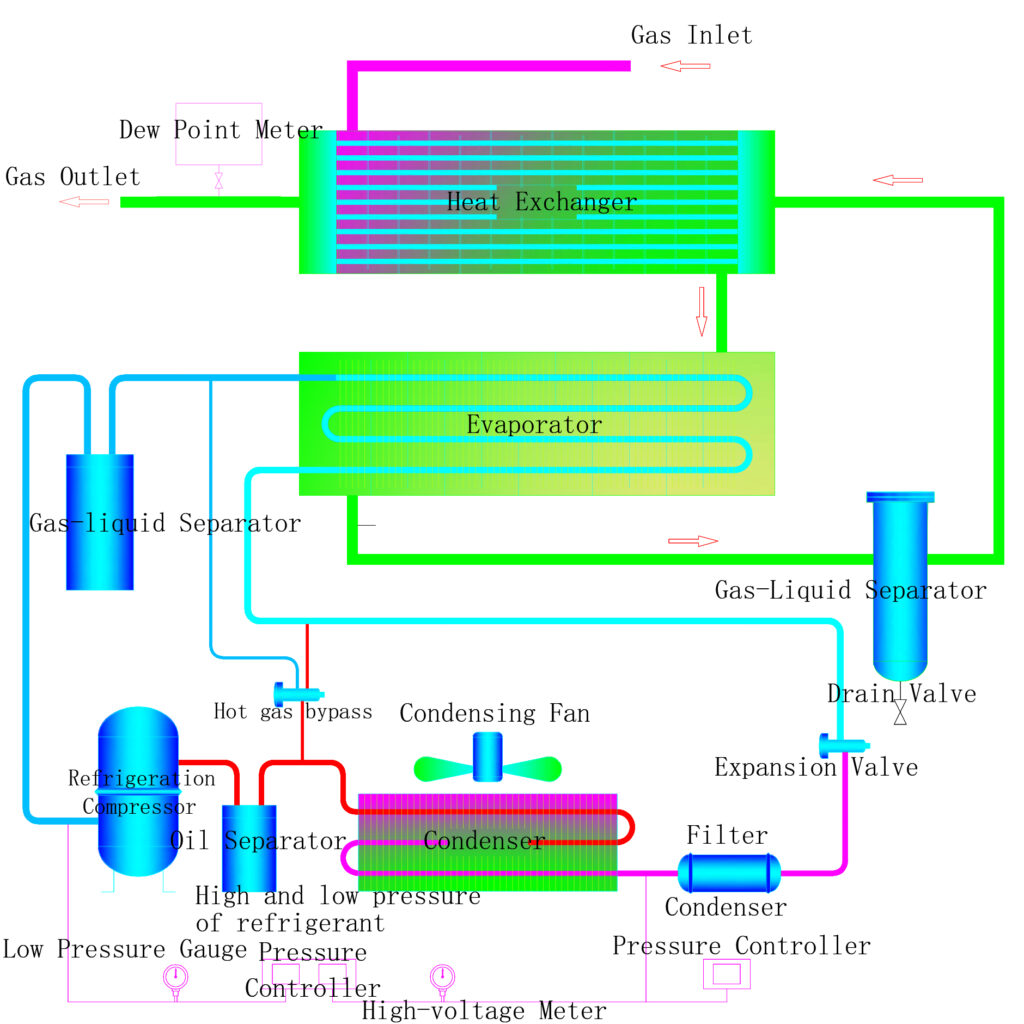
II. Equipment Process
Yipu Biogas Dehydration Unit adopts a combined process of “refrigeration pre-dehydration + adsorption deep dehydration”, with the following workflow:
- Pretreatment and Cooling: Saturated wet biogas (temperature ~45℃) from anaerobic fermentation tanks first enters the refrigeration dehydration module, where it is cooled to 2℃~10℃. At this stage, most of the water vapor condenses into liquid water, which is discharged through high-efficiency gas-liquid separators and automatic drains. Approximately 70% or more of the moisture can be removed in this step.
- Adsorption Deep Dehydration: The pre-cooled and dehydrated biogas enters molecular sieve adsorption towers (dual-tower or multi-tower). The 3A/4A molecular sieve filled in the towers deeply adsorbs residual water molecules, producing dry biogas with a water dew point as low as -40℃ ~ -75℃.
- Regeneration Cycle:
- Adsorption and Regeneration Switching: When Tower A reaches adsorption saturation, the system automatically switches to Tower B for adsorption while regenerating Tower A.
- Regeneration Process: Low-temperature regeneration is adopted. A portion of the dried finished biogas is used as regeneration gas, pressurized by a circulating compressor and heated to 150~180℃ by an electric heater, then blown back into Tower A to desorb moisture adsorbed by the molecular sieve.
- Cooling: After heating regeneration, normal-temperature dry gas is switched to cool the adsorption tower, preparing for the next adsorption cycle.
- Full-Automatic Control: The entire process is fully controlled by a PLC system, realizing continuous, unattended cycling of “adsorption-regeneration-cooling”. Regenerated waste gas is usually returned to the front end of pretreatment or vented.
III. Working Principle
The core principle of the unit is “physical condensation + Temperature Swing Adsorption (TSA)”.
- Refrigeration Dehydration Stage: Using a refrigeration system, the temperature of biogas is reduced through indirect heat exchange, leading to a sharp drop in its saturated water content, thereby condensing and separating liquid water. This is an efficient and low-cost preliminary dehydration method.
- Adsorption Dehydration Stage: Utilizing the large specific surface area and uniform microporous structure of 3A/4A molecular sieve (pore size matching the kinetic diameter of water molecules, 2.8Å), it can selectively and efficiently adsorb water molecules while barely adsorbing methane, carbon dioxide, and other molecules. This achieves deep dehydration and obtains an extremely low dew point.
IV. Core Advantages
- Deep Dehydration with Ultra-Low Dew Point: The combined process ensures dehydration efficiency, with the outlet dew point stably maintained at -40℃ ~ -75℃, far exceeding the strict requirements for power generation, purification, or pipeline transmission.
- High Efficiency, Energy Saving, and Economic Operation: The refrigeration stage uses refrigeration technology, with energy consumption much lower than direct heating regeneration. The adsorption stage adopts closed-loop regeneration, where regeneration gas is the unit’s own product gas, resulting in extremely low loss (approximately 2-5%). The overall energy consumption is reduced by more than 20% compared to traditional single heating regeneration equipment.
- Full-Automatic Intelligent Operation: The PLC control system realizes full-process automation, with functions such as fault self-diagnosis, alarm, remote data transmission, and maintenance. It greatly reduces labor costs and is particularly suitable for distributed, unattended biogas projects.
- High Reliability and Safety: Key components such as circulating compressors and control valves are selected from high-quality brands. The entire unit holds high-level explosion-proof certifications (Exd Ⅱ BT4 or Ex Ⅱ CT4), ensuring safe operation in flammable and explosive biogas environments. The protection grade reaches IP54/IP65, adapting to various harsh working conditions.
- Skid-Mounted Design and Strong Adaptability: The equipment is highly integrated and fully skid-mounted, enabling quick on-site installation. It is compatible with multiple gas sources such as biogas, natural gas, and associated gas, with a wide flow range (100-3,000 Nm³/h) and pressure adaptability (0.1-8.5 MPa), supporting flexible customization.
V. Technical Strength
- Modular Design and Customization Capability: Customized solutions can be provided for small-scale farms (100 Nm³/h) to large-scale landfills (3,000 Nm³/h), with pipe diameters ranging from DN25 to DN200 and a maximum design pressure of 9.9 MPa.
- Core Process Integration: Mature mastery of the “refrigeration + adsorption” combined process, optimizing system matching to achieve the best dehydration effect with minimal energy consumption.
- Advanced Intelligent Control System: Combines PLC with digital display instruments to real-time monitor key parameters such as pressure, temperature, and dew point. It can be integrated into a central control room to realize “smart energy” management.
- Strict Quality Control: Provides mechanical test reports and supports video factory inspection, ensuring each unit undergoes rigorous testing before leaving the factory and meets design standards.
VI. Product Introduction
- Product Name: Yipu Skid-Mounted Biogas Deep Dehydration Unit
- Brand: Yipu
- Core Process: Refrigeration pretreatment + molecular sieve adsorption deep dehydration
- Working Method: Dual-tower/multi-tower alternation, continuous cycle operation
- Control Method: PLC programmable controller, digital temperature control instrument, automatic fault alarm, support for remote maintenance
- Key Components: Circulating compressor, refrigeration compressor, control system, pneumatic control valve, molecular sieve adsorption tower, heat exchanger
- Appearance and Weight: Flexible dimensions (L: 750~12,000 mm), weight 500-12,000 kg, fully skid-mounted structure.
VII. Application Scenarios
- Biogas Power Generation Projects: Provides clean and dry fuel gas for gas internal combustion generators, preventing corrosion and efficiency loss. It is a key pretreatment equipment for grid-connected biogas power generation projects.
- Biogas (Bio-CNG/LNG) Purification: Serves as a pretreatment unit for membrane separation or PSA purification processes. Deep dehydration is an essential step to prevent ice blockage in subsequent equipment.
- Municipal Landfills: Dehydrates collected landfill gas to meet the requirements of transmission or direct utilization.
- Agricultural Waste and Sewage Treatment Plants: Dehydrates biogas generated from wastewater treatment in large-scale farms and food processing plants, for on-site boiler heating or production use.
- Industrial Fields: Widely used for process gas dehydration in industries such as chemicals, plastics, food, and steel.
VIII. Technical Indicators
| Parameter Item | Technical Indicator / Description |
|---|---|
| Product Category | Drying and Dehydration Equipment |
| Working Medium | Biogas, natural gas, oilfield associated gas, shale gas, coalbed methane, hydrogen |
| Treatment Flow | 100 ~ 3,000 Nm³/h |
| Working/Design Pressure | 0.1 ~ 8.5 MPa / 0.1 ~ 9.9 MPa |
| Inlet Condition | Saturated with water, temperature 0~45℃ (50℃) |
| Outlet Dew Point | Refrigeration dehydration: +2℃ ~ +10℃Adsorption dehydration: -40℃ ~ -75℃ |
| Adsorbent | 3A / 4A molecular sieve |
| Regeneration Method/Temperature | Low-temperature regeneration / 150 ~ 180℃ |
| Single-Tower Working Time | 12 ~ 48 hours |
| Regeneration Time | ≤ 8 hours (10 hours) |
| Power Supply and Power | 380V / 50Hz / 10 ~ 120 kW |
| System Pressure Drop | ≤ 50 kPa |
| Noise | ≤ 85 dB |
| Protection/Explosion-Proof Rating | IP54 or IP65 / Exd Ⅱ BT4 or Ex Ⅱ CT4 |
| Outlet Filtration Precision | ≤ 3 μm |
| Core Advantages | Stable and efficient equipment, fully automatic operation, energy saving and environmental protection, remote maintenance |
Technical Parameter Table of Biogas Drying and Dehydration Equipment
| Item | Parameter | Item | Parameter |
|---|---|---|---|
| Product Category | Biogas Drying and Dehydration Equipment | Working Medium | Biogas, natural gas, oilfield associated gas, shale gas, coalbed methane, hydrogen |
| Brand | Yipu | Place of Origin | Zhejiang, China |
| Working Flow | 100~3,000 Nm³/h | Core Components | Circulating compressor, control system, refrigeration compressor, control valve |
| Core Advantages | Stable and efficient equipment, fully automatic operation, energy-saving and environmentally friendly, remote maintenance | Application Industries | Biogas engineering and anaerobic fermentation industry, biogas power generation, bio-natural gas/vehicle gas, industrial fuel, chemical raw materials, etc. |
| Mechanical Test Report | Available | Video Factory Inspection | Available |
| Working Pressure | 0.1~8.5 Mpa | Inlet Temperature | 0~45℃ (50℃) |
| Inlet Pressure Dew Point | Saturated with water | Single-Tower Continuous Working Time | 12~48 h |
| System Design Pressure | 0.1~9.9 Mpa | Regeneration Time | ≤8 h (10 h) |
| Adsorbent | 3A/4A molecular sieve | Outlet Dew Point (Refrigeration Dehydration) | 2℃~10℃ |
| Outlet Dew Point (Adsorption Dehydration) | -40℃~-75℃ | ||
| Regeneration Cooling Method | Air cooling/Water cooling | Outlet Filtration Precision | ≤3 μm |
| Power Supply/Power | 380V/50Hz/10~120 kW | Protection Grade | IP54 or IP65 |
| Import and Export Pressure Drop | ≤50 kPa | Explosion-Proof Grade | ExdⅡ BT4, ExdⅡ CT4 |
| Noise | ≤85 dB | Regeneration Gas Heating Temperature | 150~180℃ |
| Overall Dimensions | L: (750~12,000) mmW: (450~2,950) mmH: (760~3,200) mm | Equipment Weight | 500-12,000 kg |
| Import and Export Pipe Diameter | DN25~DN200 | ||
| Working Method | Dual-tower/multi-tower alternating “adsorption-regeneration” for continuous gas supply | Regeneration Method | Closed/open cycle, pressure reduction/isobaric regeneration/heating regeneration |
| Control Method | PLC programmable controller, digital temperature control instrument, automatic fault alarm | Switching Method | Manual/Automatic |
Packaging, Shipping Information and Quotation
| Item | Details |
|---|---|
| Sales Unit | Single product/set |
| Single Package Dimension | 16008001400 (LWH) mm |
| Single Product Gross Weight | 5000 kg |
| Packaging Method | Wooden case/three-proof cloth (waterproof, mildew-proof, corrosion-resistant) |
| Quotation | $5,000 ~ $30,000 |