
PSA Pressure Swing Adsorption Nitrogen Generator


System Overview Separation Mechanism Utilizes the difference in adsorption rates of carbon molecular sieves (CMS) for oxygen (smaller molecular size, faster diffusion) and nitrogen (larger molecular size, slower diffusion). Oxygen is preferentially adsorbed, and nitrogen is enriched in the gas phase to achieve separation. Pressure Swing Adsorption (PSA) Through a cyclic process of pressurized adsorption…
System Overview
Separation Mechanism
Utilizes the difference in adsorption rates of carbon molecular sieves (CMS) for oxygen (smaller molecular size, faster diffusion) and nitrogen (larger molecular size, slower diffusion). Oxygen is preferentially adsorbed, and nitrogen is enriched in the gas phase to achieve separation.
Pressure Swing Adsorption (PSA)
Through a cyclic process of pressurized adsorption (oxygen adsorption) and depressurized regeneration (oxygen release), combined with a dual-tower parallel design, continuous nitrogen production is realized.
Intelligent Control
The software automatically switches adsorption/regeneration cycles, allowing adjustable purity and flow rate. It supports remote monitoring and features high automation (unattended operation is feasible).
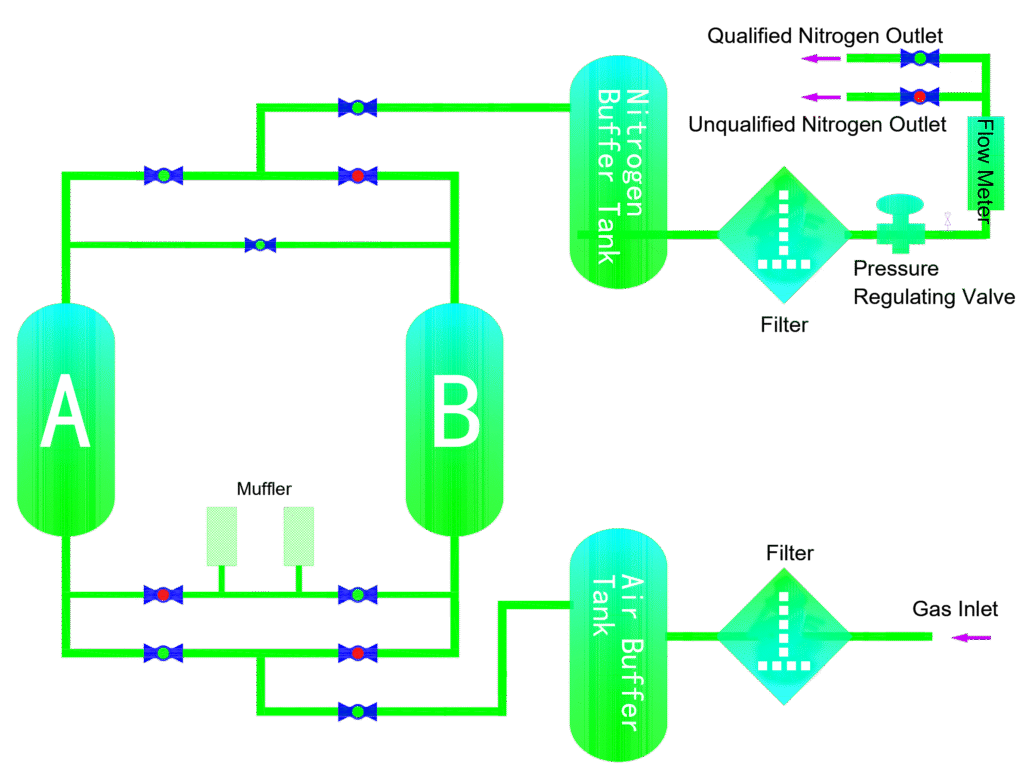
Working Principle
Taking air as the raw material, it separates nitrogen and oxygen from the air by utilizing the selective adsorption performance of a high-efficiency, high-selectivity solid adsorbent for nitrogen and oxygen. The separation of nitrogen and oxygen by carbon molecular sieves is mainly based on the different diffusion rates of these two gases on the surface of the carbon molecular sieve. Gases with smaller diameters (oxygen) diffuse faster and enter the solid phase of the molecular sieve in larger quantities. In this way, an enriched nitrogen component can be obtained in the gas phase. After a period of time, the adsorption of oxygen by the molecular sieve reaches equilibrium. According to the characteristic that carbon molecular sieves have different adsorption capacities for adsorbed gases under different pressures, the pressure is reduced to desorb oxygen from the carbon molecular sieve. This process is called regeneration. The pressure swing adsorption method usually uses two towers in parallel, alternately performing pressurized adsorption and depressurized regeneration to obtain a continuous nitrogen flow.
Product Features
- Based on the pressure swing adsorption process principle, mature and reliable.
- Intelligent software cycle switching; purity and flow rate can be adjusted within a certain range.
- Reasonable configuration of relevant system components, low failure rate.
- Rational internal structure ensures uniform gas flow distribution and reduces high-speed gas impact.
- Improved process design for optimal usage effects.
- Unique molecular sieve protection measures to extend the service life of carbon molecular sieves.
- Intelligent interlocking unqualified nitrogen venting device to ensure product nitrogen quality.
- Optional configurations include nitrogen device flow rate and purity automatic adjustment systems, remote control systems, etc.
- The whole machine is delivered from the factory with no need for on-site foundation installation indoors, and pipeline matching installation is convenient.
- Simple operation, stable operation, high automation, and unattended operation can be realized.
Core Advantages
Mature & Reliable
- Adopts Pressure Swing Adsorption (PSA) technology
- Stable technology and high separation efficiency
Intelligent & Controllable
- Supports automatic adjustment of purity and flow rate
- Enables remote monitoring and unattended operation
Efficient & Durable
- Optimized gas flow distribution to reduce impact
- Extends molecular sieve lifespan and lowers maintenance costs
Safe & Stable
- Intelligent interlocking protection and automatic venting of unqualified nitrogen
- Ensures reliable output quality
Flexible & Adaptable
- Optional automatic adjustment system
- Meets the nitrogen purity and flow rate requirements of different industries
Easy Installation
- Modular design of the whole machine, no complex infrastructure required
- Ready-to-use with simple operation
Technical Strength
Leading Adsorption Dehydration Technology
- Adopts high-performance molecular sieve adsorbents with high water absorption capacity and resistance to acidic gas (H₂S/CO₂) corrosion, ensuring deep dehydration effect with dew point ≤ -70℃.
- Original thermal nitrogen regeneration process reduces energy consumption by 30% compared with traditional electric heating regeneration, and integrates waste heat recovery system to significantly improve energy efficiency.
Modular & Customized Design Capability
- Core equipment adopts modular prefabrication, supporting rapid deployment (installation cycle reduced by 50%), suitable for diverse scenarios such as offshore platforms, onshore gas fields, and LNG pretreatment.
- Can customize single-tower, dual-tower, or multi-tower parallel systems according to customer needs, with processing capacity covering 10,000~1,000,000 Nm³/d, flexibly matching gas fields of different scales.
Intelligent Control & Remote Operation and Maintenance
- Equipped with PLC+IoT intelligent control system, real-time monitoring of key parameters such as pressure, temperature, and dew point, supporting fault early warning and automatic adjustment.
- Optimizes adsorption-regeneration cycles through cloud big data analysis, extends molecular sieve lifespan, and reduces operation and maintenance costs by 10%-15%.
Energy-Saving & Environmental Protection Technology
- Zero-emission design of regeneration tail gas, complying with EU CE, US EPA and other environmental standards.
- Energy consumption is 25%-40% lower than traditional triethylene glycol (TEG) dehydration systems, helping customers achieve carbon emission reduction goals.
Long-Cycle Operation Reliability
- Molecular sieves adopt anti-pulverization coating technology, with a service life of more than 5 years, reducing replacement frequency.
- Key components (such as valves and instruments) are selected from international first-tier brands (e.g., Siemens, Emerson), with MTBF (Mean Time Between Failures) exceeding 100,000 hours.
Strong R&D & Engineering Experience
- Possesses more than 19 dehydration technology patents and software copyrights; the R&D team is led by doctors and cooperates closely with universities and colleges.
- Has over 1,000 successful cases worldwide, covering extreme working conditions such as high-sulfur gas fields in the Middle East and low-temperature environments in the Arctic.
Comparison Between VPSA and PSA Nitrogen Generation
| Characteristics | VPSA (Vacuum Pressure Swing Adsorption) | PSA (Pressure Swing Adsorption) |
|---|---|---|
| Operating Pressure | Low pressure (0.3-0.8 barg) | Medium-high pressure (4-8 barg) |
| Regeneration Method | Vacuum desorption | Atmospheric desorption |
| Core Equipment | Blower + Vacuum pump | Air compressor + Atmospheric relief valve |
| Energy Consumption | Low, suitable for large-scale production | Relatively high |
| Nitrogen Output | Large (usually > 100 Nm³/h) | Small to medium (several to hundreds of Nm³/h) |
| Nitrogen Purity | Usually up to 99.5% – 99.999% | Also up to 99.5% – 99.999% |
| Applicable Scenarios | Chemical industry, metallurgy, float glass, large-scale food preservation, etc. | Electronics, small chemical industry, laser cutting, small to medium injection molding, etc. |
Application Scenarios
Electronics Industry
Used in the manufacturing processes of semiconductors, liquid crystal panels, photovoltaic cells, etc., providing high-purity nitrogen (above 99.999%) to prevent oxidation and pollution, and ensure the yield of precision components.
Food & Beverage Industry
Applied in food packaging (e.g., nitrogen-filled preservation), beer and beverage filling, etc., inhibiting bacterial growth and extending shelf life. Usually, nitrogen with a purity of 95%~99.9% is required.
Chemical & Petroleum Industry
Utilized for inert atmosphere protection (e.g., reactor and storage tank nitrogen sealing), pipeline purging, etc., preventing explosions and oxidation. The general purity requirement is 99.5%~99.9%.
Metal Heat Treatment & Welding
Provides nitrogen protection in processes such as annealing, quenching, and laser cutting, preventing metal oxidation and improving processing quality. Usually, nitrogen with a purity of around 99.9% is used.