
Molecular Sieve Regeneration Adsorption Dehydration System


Overview The Yipu Molecular Sieve Regenerative Adsorption Dehydration System represents the advanced technological level in the field of gas dehydration. Through its regenerative technical route, outstanding deep purification performance, stable and reliable continuous operation, and convenient and economical intelligent operation and maintenance, it provides customers with a comprehensive solution. It not only solves current dehydration…
Overview
The Yipu Molecular Sieve Regenerative Adsorption Dehydration System represents the advanced technological level in the field of gas dehydration. Through its regenerative technical route, outstanding deep purification performance, stable and reliable continuous operation, and convenient and economical intelligent operation and maintenance, it provides customers with a comprehensive solution. It not only solves current dehydration challenges but also creates long-term value returns for customers by reducing the total lifecycle cost.
I. Market Pain Points
In the field of industrial gas purification, deep dehydration is a universal and critical demand. Traditional drying methods or non-regenerative systems have numerous limitations. Yipu’s regenerative adsorption system precisely addresses the following core industry pain points:
- High Operational CostsDisposable desiccants (e.g., alumina, silica gel) or frequently replaced molecular sieves result in persistently high material costs and waste disposal expenses.
- Insufficient Dehydration DepthMany drying methods fail to achieve the extremely low dew point (<-50℃) required by harsh processes (e.g., cryogenic liquefaction, chemical synthesis), restricting production efficiency and product quality.
- Inability to Operate ContinuouslySingle-tower adsorption equipment must be shut down during desiccant regeneration or replacement, causing interruptions to downstream production processes and affecting overall production efficiency and stability.
- Low Automation Level and Complex Operation & MaintenanceReliance on manual operation for switching and regeneration not only incurs high labor costs but also carries the risk of operational errors, making it difficult to implement in remote or hazardous sites.
- High Energy Consumption and Product Gas LossInefficient regeneration processes (e.g., open-loop regeneration) consume large amounts of qualified product gas as regeneration gas, resulting in energy waste and reduced yield.
- Environmental PressureImproper disposal of waste desiccants poses environmental problems, failing to comply with increasingly stringent environmental regulations.
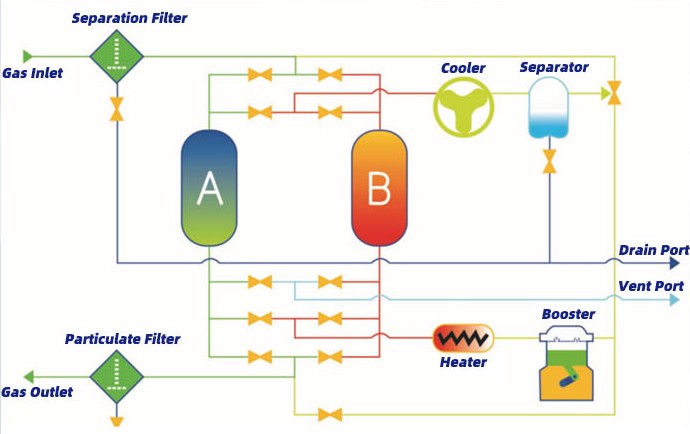
II. System Process
The Yipu system adopts the classic “adsorption-regeneration-cooling” cycle process, achieving continuous gas supply through dual-tower or multi-tower configuration:
- Inlet Gas Preprocessing UnitWet feed gas first enters the system and passes through a precision filter to remove solid particles, liquid droplets, and aerosols, providing clean and protected feed for the molecular sieve adsorption towers.
- Dual-Tower/Multi-Tower Adsorption Dehydration Unit (Core)
- Adsorption Process (Tower A): Preprocessed gas enters a molecular sieve tower in adsorption state (e.g., Tower A). As the gas flows through the 3A or 4A molecular sieve bed, water molecules are selectively and efficiently adsorbed into the microporous structure of the molecular sieve. Deeply dried gas flows out from the top of the tower.
- Parallel Regeneration Process (Tower B): While Tower A is in adsorption, another saturated molecular sieve tower (Tower B) is undergoing regeneration, which includes two stages: heating regeneration and cooling.
- Heating Regeneration: The system extracts a portion of self-produced dry purified gas, heats it to 150-180℃ via a heater, and then passes it through Tower B in reverse. The high-temperature gas desorbs moisture adsorbed deep within the molecular sieve, restoring its drying capacity.
- Cooling: After regeneration, heating is stopped, and Tower B is purged and cooled with cooled gas to restore the bed temperature to a suitable adsorption level (typically 40-50℃).
- Automatic Switching and Continuous Gas SupplyWhen Tower A approaches adsorption saturation (based on a preset 12-48 hour cycle or online dew point monitoring), the system automatically switches valves via the PLC controller, directing wet feed gas to Tower B (which has completed regeneration and cooling) while Tower A enters the regeneration stage. This cyclic alternation ensures 24/7 uninterrupted supply of dry gas.
- Purified Gas Delivery UnitAfter deep dehydration in the adsorption tower, the atmospheric pressure dew point of the gas can stably reach -55℃ to -70℃. The gas then passes through an outlet filter (precision ≤3μm) for final protection, ensuring no molecular sieve dust is carried over, and producing high-quality dry gas.
III. Working Principle
The core technical principle of the system is temperature and pressure swing adsorption (TPSA) combined with the shape-selective adsorption effect of molecular sieves.
- Shape-Selective Adsorption Effect: The pore size of 3A molecular sieve (approximately 3Å) only allows smaller water molecules (2.8Å) to enter and be strongly adsorbed, effectively excluding most hydrocarbon molecules, making it an ideal choice for deep dehydration. 4A molecular sieve has a slightly larger pore size (approximately 4Å), which can adsorb partial hydrogen sulfide and heavier hydrocarbons while dehydrating, suitable for scenarios requiring synergistic purification.
- Temperature and Pressure Swing Adsorption:
- Adsorption Stage: Conducted at ambient temperature and system pressure (0.1-8.0MPa), where molecular sieves exhibit high adsorption capacity for water molecules.
- Regeneration Stage: The adsorption capacity of molecular sieves for water molecules is significantly reduced by lowering pressure (depressurization regeneration) and increasing temperature (150-180℃ heating), allowing adsorbed moisture to desorb and the molecular sieve to regenerate. The cooling process prepares for the next adsorption cycle.
IV. Core Advantages
- Excellent Dehydration Depth and StabilityWith an outlet dew point of ≤-70℃, it meets the most demanding industrial application requirements, fundamentally solving hydrate ice blockage, equipment corrosion, and process poisoning issues.
- Uninterrupted Continuous Gas SupplyThe dual-tower/multi-tower alternating working mode ensures an uninterrupted supply of dry gas for downstream users, guaranteeing the continuous and stable operation of main process equipment.
- Low Total Lifecycle CostMolecular sieves have a long service life (typically 2-5 years), and their regenerative nature completely eliminates the costs of frequent desiccant replacement and waste disposal, delivering significant long-term operational economy.
- Fully Automatic Intelligent OperationBased on PLC full-automatic control, it realizes one-key start-stop, automatic switching, fault alarm, and remote monitoring. It significantly reduces manual intervention and O&M costs, making it particularly suitable for unattended sites.
- High Energy Efficiency and Yield
- Closed-loop regeneration technology maximizes recovery of regeneration gas, minimizing product gas loss.
- Low inlet and outlet pressure drop (≤50kPa) reduces system energy consumption.
- Precise control of regeneration gas heating temperature avoids energy waste.
- High Safety and ReliabilityExd Ⅱ BT4 explosion-proof rating and IP54/IP65 protection rating ensure safe operation in flammable and explosive environments. The system design pressure (up to 9.0MPa) provides ample safety margin.
V. Technical Strength
- Mature Process Package DesignWith in-depth understanding of TSA/PSA processes and rich application experience, it can provide optimal process configurations (e.g., air cooling/water cooling, closed-loop/open-loop) based on specific gas source conditions and purification targets.
- Modular and Serialized CapabilitiesOffers serialized products with pipe diameters from DN50 to DN200 and flow rates covering 500 to 20,000 Nm³/h, demonstrating strong modular design and rapid delivery capabilities.
- Scientific Selection and Application of Core AdsorbentsPossesses a deep understanding of the performance differences and application scenarios of 3A/4A molecular sieves, providing professional selection advice to balance dehydration depth, pollution resistance, and operational costs.
- Strict Quality Assurance SystemAvailable mechanical test reports and factory inspection videos reflect strict full-process quality control from design, procurement, and manufacturing to testing.
- Intelligence and InterconnectivityThe built-in PLC system and standard industrial communication interfaces provide a solid foundation for equipment integration into factory DCS systems, enabling digital management and predictive maintenance.
VI. Product Introduction
- Product Category: Molecular Sieve Regenerative Adsorption Dehydration System
- Brand: Yipu
- Core Components: Molecular sieve adsorption towers, 3A/4A molecular sieves, regeneration gas heater, PLC electrical control system, switching valves
- Working Mode: Dual-tower/multi-tower alternation, continuous cycle operation
- Control Mode: PLC programmable controller with full-automatic control and manual intervention support
- Place of Origin: Zhejiang, China
This system is a mature and high-performance industrial gas deep purification equipment. With its regenerative, continuous operation, and deep dehydration characteristics, it has become an ideal alternative to traditional drying methods.
VII. Application Scenarios
- Natural Gas Sector: Shale gas/coalbed methane wellsite dehydration, deep dehydration of feed gas for CNG/LNG filling stations and liquefaction plants, dehydration of pipeline gas in urban gate stations and pressure regulating stations.
- Energy and Environmental Protection Sector: Deep dehydration of biogas and landfill gas before purification.
- Industrial Gas Sector: Deep drying of instrument air and process air, preprocessing of feed air for air separation units, dehydration of process gases in the chemical industry (e.g., ammonia synthesis gas, methanol synthesis gas).
- Other Sectors: Any industrial scenario requiring dry gas with a low dew point.
VIII. Key Technical Indicators
| Indicator Category | Parameter Details | Technical & Market Significance |
|---|---|---|
| Processing Capacity | 500 ~ 20,000 Nm³/h | Excellent wide-load adaptability, covering numerous application scenarios |
| Working Pressure | 0.1 ~ 8.0 MPa | Strong working condition compatibility, handling various pressure requirements |
| Outlet Dew Point | ≤ -55℃ ~ -70℃ | Core performance indicator, meeting industrial-grade deep dehydration standards |
| Adsorbent & Regeneration | 3A/4A Molecular Sieve, Heated Regeneration | Technical cornerstone, enabling regenerative, continuous, and deep dehydration |
| Continuous Operation Time | 12 ~ 48 h/tower | Reflection of high reliability, ensuring long-cycle stable operation |
| Regeneration Time | ≤ 8 h | Reflection of high efficiency, quickly restoring adsorption capacity |
| Control & Automation | PLC, Fully Automatic, Fault Alarm | Core of intelligence, realizing unmanned operation and maintenance |
Technical Parameter Sheet of Molecular Sieve Regenerative Adsorption Dehydration System
| Item | Specification | Item | Specification |
|---|---|---|---|
| Product Category | Molecular Sieve Regenerative Adsorption Dehydration System | Working Medium | Oilfield Associated Gas, Shale Gas, Natural Gas, Coalbed Methane, Biogas |
| Brand | Yipu | Place of Origin | Zhejiang, China |
| Working Flow Rate | 500~20,000 Nm³/h | Core Components | Motor, Compressor, Adsorption Tower, Molecular Sieve, Filter, Booster, Cooler, Separator, Heater, Control Valve & Control System |
| Core Advantages | Stable & Efficient Operation, Fully Automatic, Energy-Saving & Environmentally Friendly, Remote Maintenance | Application Scenarios | Shale Gas & Wellhead Gas Drying/Dehydration, Urban Pipeline Natural Gas Dehydration, Oilfield Associated Gas & Coalbed Methane Drying/Dehydration, Biogas Drying/Dehydration |
| Mechanical Test Report | Available | Factory Inspection Video | Available |
| Working Pressure | 0.1~8.0 Mpa | Inlet Temperature | 0~40℃ (50℃) |
| Inlet Pressure Dew Point | 0.6 Mpa/-13℃/Saturated with Water | Single Tower Continuous Working Time | 12~48 h |
| System Design Pressure | 1.0~9.0 Mpa | Regeneration Time | ≤8 h (10 h) |
| Adsorbent | 3A/4A Molecular Sieve | Outlet Atmospheric Dew Point | ≤-55℃~-70℃ |
| Regeneration Cooling Method | Air Cooling/Water Cooling | Outlet Filtration Precision | ≤3 μm |
| Power Supply/Power | 380V/50Hz/12.30~150 kW | Protection Class | IP54 or IP65 |
| Inlet & Outlet Pressure Drop | ≤50 kPa | Motor Explosion-Proof Class | ExdⅡ BT4 |
| Noise Level | ≤85 dB | Regeneration Gas Heating Temperature | 150~180℃ |
| Overall Dimensions | L: (2500~8000) mmW: (1600~3000) mmH: (2350~2850) mm | Equipment Weight | 2000~7000 kg |
| Working Method | “Dual-Tower/Multi-Tower Alternating Adsorption-Regeneration,Continuous Gas Supply” | Regeneration Method | “Closed/Open Loop, Depressurization/IsobaricRegeneration/Heated Regeneration” |
| Control Mode | “PLC Programmable Controller, Digital Temperature ControlInstruments, Automatic Fault Alarm” | Switching Mode | Manual/Automatic |
Packaging, Shipping Information & Quotation
| Item | Specification |
|---|---|
| Sales Unit | Single Unit/Set |
| Individual Packaging Dimensions | 2500×2000×2850 (L×W×H) mm |
| Individual Product Gross Weight | 3000 kg |
| Packaging Method | Wooden Case/Triple-Proof Cloth (Waterproof, Mildewproof, Corrosion-Resistant) |
| Quotation | $28,000 ~ $100,000 |