
Gas Drying and Dehydration System


Yipu Gas Drying & Dehydration System is a universal industrial-grade solution integrating deep purification, wide adaptability, intelligent control, and high reliability. It is not only a tool to solve moisture issues in gases but also a core guarantee for the stable, efficient, and safe operation of customers’ key process flows. I. Market Pain Points Gas…
Yipu Gas Drying & Dehydration System is a universal industrial-grade solution integrating deep purification, wide adaptability, intelligent control, and high reliability. It is not only a tool to solve moisture issues in gases but also a core guarantee for the stable, efficient, and safe operation of customers’ key process flows.
I. Market Pain Points
Gas drying is a crucial and widespread link in the processing of natural gas and other industrial gases. Regardless of the gas source, undehydrated wet gas brings a series of common industry pain points:
- Pipeline and Equipment Ice Blockage: During transportation or processing, when gas temperature drops, moisture in the gas forms natural gas hydrates (ice), blocking valves, instruments, pipelines, and equipment. This leads to system shutdown and high maintenance costs.
- Corrosion and Equipment Wear: Moisture combines with acidic components (such as CO₂, H₂S) in the gas to form acidic solutions, causing severe corrosion to metal equipment like pipelines, storage tanks, and compressors. This shortens equipment service life and poses potential safety hazards.
- Process Interference and Product Quality Decline:
- In industries such as chemical and electronics, moisture can poison catalysts, affecting chemical reaction efficiency and product purity.
- For liquefaction processes (e.g., LNG, liquid nitrogen), moisture freezes in low-temperature equipment, resulting in equipment damage and production shutdown.
- For fuel gases (e.g., CNG, biogas), moisture reduces calorific value and may cause malfunctions in end-user equipment.
- Inaccurate Metering and Trade Disputes: Liquid water or hydrates affect the measurement accuracy of flow meters, leading to unfair trade settlements and economic losses/disputes.
- High Operation and Maintenance Costs and Automation Demand: Traditional dehydration methods or non-automated equipment require frequent manual intervention and maintenance. In remote stations (e.g., well sites) or continuous operation conditions, labor costs are high and response speed is slow.
II. System Process
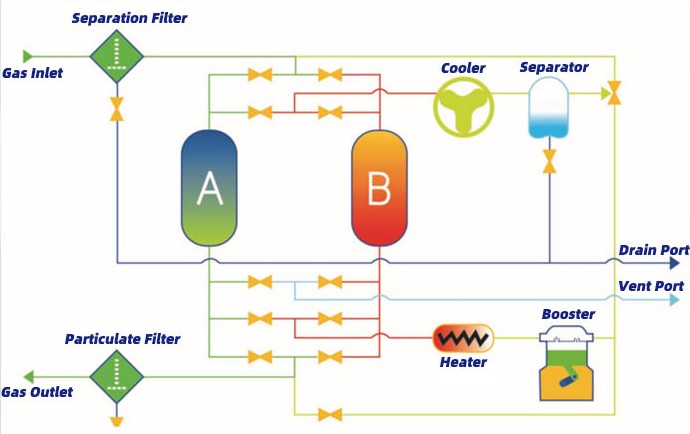
Yipu Gas Drying & Dehydration System adopts the classic pressure swing adsorption principle, featuring an exquisite process design and reliable operation:
- Gas Inlet Pretreatment Unit: Wet feed gas from different sources first enters the system and passes through an inlet filter separator to remove entrained solid particles, providing clean feed for the core adsorption towers.
- Dual-Tower/Multi-Tower Adsorption Dehydration Unit (Core):
- Adsorption Process: The pretreated gas flows from bottom to top through an adsorption tower filled with 3A or 4A molecular sieves. With a large specific surface area and selective adsorption capacity, the molecular sieves efficiently and deeply adsorb water molecules. The dried gas flows out from the top of the tower.
- Automatic Switching and Continuous Gas Supply: Before the working tower reaches adsorption saturation (based on preset time or online dew point monitoring), the system automatically switches valves via a PLC controller, diverting gas flow to the standby tower that has completed regeneration, ensuring uninterrupted supply of dry gas.
- Regeneration and Cooling Unit:
- Heated Regeneration: The saturated tower is regenerated. The system adopts a closed or open cycle mode, heating a portion of the dry product gas from the outlet to 150-180℃ and then passing it into the adsorption tower in the reverse direction (from top to bottom). The high-temperature and low-pressure environment desorbs moisture adsorbed by the molecular sieves, restoring their drying capacity.
- Cooling: After regeneration, the high-temperature adsorption tower needs to be cooled. The system introduces cooling gas into the tower via air cooling or water cooling, reducing its temperature to a suitable adsorption temperature (usually 40-50℃) in preparation for the next working cycle. The regenerated gas is cooled to separate and discharge liquid water.
- Purified Gas Transmission Unit: The deeply dehydrated dry gas has a stable atmospheric pressure dew point of -55℃ to -70℃. Subsequently, the gas passes through an outlet filter (precision ≤3μm) to ensure no adsorbent dust is carried over, ultimately producing clean, ultra-dry high-quality gas that meets downstream application requirements.
III. Working Principle
The core technical principle of this system is the perfect combination of pressure swing adsorption and selective adsorption of molecular sieves.
- Selective Adsorption: 3A molecular sieves have a pore size of approximately 3 angstroms, which can preferentially and strongly adsorb smaller water molecules (2.8 angstroms) while effectively excluding most hydrocarbon molecules, making them an ideal choice for deep dehydration. 4A molecular sieves have a slightly larger pore size and can simultaneously remove partial H₂S and heavier hydrocarbon molecules during deep dehydration, suitable for occasions with specific purification requirements.
- Pressure Swing Adsorption: The system performs adsorption at ambient temperature and relatively high pressure; regeneration is carried out at lower pressure (or atmospheric pressure) and higher temperature (150-180℃). Utilizing the characteristic of molecular sieves having significantly varying adsorption capacities under different pressures and temperatures, periodic changes in pressure and temperature realize the cyclic regeneration of the adsorbent’s working capacity, thereby ensuring continuous deep drying of gases.
IV. Core Advantages
- Outstanding Dehydration Depth and Stability: The outlet dew point is as low as -70℃, capable of meeting the most demanding process requirements and fundamentally solving hydrate ice blockage and corrosion issues.
- Comprehensive Working Condition Adaptability: The extremely wide working flow range (500-20,000 Nm³/h) and pressure range (0.1-8.0 MPa) enable flexible adaptation to various application scenarios from small wellheads to large-scale processing stations without additional customization.
- Full-Automatic Intelligent Operation: PLC-based programmable controllers realize full-process automated control, including automatic switching, fault diagnosis, alarm, and protection. Supporting remote monitoring and maintenance, it greatly reduces labor costs and operational risks, achieving “unattended operation.”
- High Efficiency, Energy Saving and Environmental Protection:
- Closed-cycle regeneration technology minimizes product gas consumption and improves overall yield.
- The system pressure drop as low as 50kPa reduces energy consumption for front-end compression or transportation.
- Molecular sieves are inorganic solid adsorbents with no toxic chemical emissions, ensuring a clean and environmentally friendly process.
- High Reliability and Long-Service-Life Design: The single-tower continuous working time is up to 48 hours, with short regeneration time (≤8h) and high equipment utilization. The system design pressure is as high as 9.0MPa, providing sufficient safety margin. The Exd Ⅱ BT4 explosion-proof rating and IP54/IP65 protection rating ensure safe and stable operation in harsh industrial environments.
V. Technical Strength
- Modular and Platform-Based Design Capabilities: Offers standardized series product sizes and configurations, demonstrating strong modular design capabilities and the ability to quickly respond to diverse needs of customers in different industries.
- Flexible Process Package Integration: Masters various process combinations such as “air cooling/water cooling,” “closed/open cycle,” and “isobaric/depressurization regeneration,” and can provide optimal technical solutions based on customers’ on-site conditions (climate, water resources) and process requirements.
- Precise Application of Core Adsorbents: Conducts in-depth research on the performance, service life, and application scenarios of 3A/4A molecular sieves, and can provide professional selection suggestions based on specific gas source components and purification goals.
- Strict Quality and Performance Verification: Available mechanical test reports and video factory inspections reflect the full-process quality control system from raw materials, manufacturing to overall performance testing, ensuring the reliability and promised performance of delivered equipment.
- Intelligence and Industry 4.0 Interfaces: Integrates PLC control systems and standard industrial communication protocols, providing a solid foundation for equipment to connect to factory DCS systems, realize data-driven management, and predictive maintenance.
VI. Product Introduction
- Product Category: Gas Drying & Dehydration System
- Brand: Yipu
- Core Components: Adsorption tower, 3A/4A molecular sieve, regenerated gas heater, PLC electrical control system, switching valve group
- Working Mode: Dual-tower/multi-tower alternation, continuous cyclic operation
- Control Method: PLC full-automatic control, supporting manual/automatic switching
- Place of Origin: Zhejiang, China
Yipu Gas Drying & Dehydration System is a high-performance, multi-purpose industrial gas purification platform equipment. With its outstanding dehydration capacity, high reliability, and intelligent level, it serves multiple energy and industrial fields.
VII. Application Scenarios
- Natural Gas Field: Dehydration of shale gas, coalbed methane, and oilfield associated gas at well sites and gathering stations; dehydration of urban gas pipeline network pressure regulating stations; deep dehydration of feed gas for CNG/LNG filling stations and liquefaction plants.
- Energy and Environmental Protection Field: Deep dehydration and purification of biogas and landfill gas before decarbonization.
- Industrial Gas Field: Deep drying of instrument air and process air; pretreatment of feed air for air separation units; dehydration of chemical synthesis gas, etc.
VIII. Key Technical Indicators
| Indicator Category | Parameter Details | Technical and Market Significance |
|---|---|---|
| Processing Capacity | 500 ~ 20,000 Nm³/h | Platform advantage, covering an extremely wide range of application scales |
| Working Pressure | 0.1 ~ 8.0 MPa | Excellent adaptability to various pressure conditions |
| Outlet Dew Point | ≤ -55℃ ~ -70℃ | Core performance, reaching industry-leading deep dehydration level |
| Adsorbent | 3A / 4A Molecular Sieve | Technical core, accurately matching different purification requirements |
| Continuous Working Time | 12 ~ 48 h/tower | High reliability, ensuring continuous and stable operation of downstream processes |
| Regeneration Time | ≤ 8 h | High efficiency, quickly restoring standby status |
| Control and Automation | PLC, Full-Automatic, Fault Alarm | Intelligence, reducing operation and maintenance costs and improving management level |
| Energy Consumption and Environmental Protection | Closed-cycle regeneration, low pressure drop, clean process | Economical and environmentally friendly, in line with green energy-saving trends |
| Safety Certification | Explosion-Proof: EXD Ⅱ BT4; Protection: IP54/IP65 | Safety guarantee, meeting stringent industrial safety standards |
Gas Drying & Dehydration System – Technical Specification Sheet
| Item | Specification | Item | Specification |
|---|---|---|---|
| Product Category | Gas Drying & Dehydration System | Working Medium | Oilfield Associated Gas, Shale Gas, Natural Gas, Coalbed Methane, Biogas |
| Brand | Yipu | Place of Origin | Zhejiang, China |
| Working Flow Rate | 500~20,000 Nm³/h | Core Components | Motor, Compressor, Adsorption Tower, Molecular Sieve, Filter, Booster, Cooler, Separator, Heater, Control Valve & Control System |
| Core Advantages | Stable & Efficient Operation, Full-Automatic Control, Energy-Saving & Environmental Protection, Remote Maintenance | Application Industries | Shale Gas & Wellhead Gas Drying/Dehydration, Urban Pipeline Network Natural Gas Drying, Oilfield Associated Gas & Coalbed Methane Drying/Dehydration, Biogas Drying/Dehydration |
| Mechanical Test Report | Available | Video Factory Inspection | Available |
| Working Pressure | 0.1~8.0 MPa | Inlet Temperature | 0~40℃ (50℃) |
| Inlet Pressure Dew Point | 0.6 MPa/-13℃/Water-Saturated | Single-Tower Continuous Working Time | 12~48 h |
| System Design Pressure | 1.0~9.0 MPa | Regeneration Time | ≤8 h (10 h) |
| Adsorbent | 3A/4A Molecular Sieve | Outlet Atmospheric Dew Point | ≤-55℃~-70℃ |
| Regeneration Cooling Method | Air Cooling/Water Cooling | Outlet Filtration Precision | ≤3 μm |
| Power Supply/Power | 380V/50Hz/12.30~150 kW | Protection Class | IP54 or IP65 |
| Inlet & Outlet Pressure Drop | ≤50 kPa | Motor Explosion-Proof Class | ExdⅡ BT4 |
| Noise Level | ≤85 dB | Regenerated Gas Heating Temperature | 150~180℃ |
| Overall Dimensions | L: (2500~8000) mmW: (1600~3000) mmH: (2350~2850) mm | Equipment Weight | 2000~7000 kg |
| Inlet & Outlet Pipe Diameter | DN50~DN200 | ||
| Working Mode | “Dual-Tower/Multi-Tower Alternating ‘Adsorption-Regeneration’Continuous Gas Supply” | Regeneration Method | “Closed/Open Cycle, Depressurization/IsobaricRegeneration/Heated Regeneration” |
| Control Method | “PLC Programmable Controller, Digital Temperature ControlInstrument, Automatic Fault Alarm” | Switching Mode | Manual/Automatic |
Packaging, Shipping & Quotation Information
| Item | Specification | Item | Specification |
|---|---|---|---|
| Sales Unit | Single Unit/Set | Individual Package Dimension | 2500×2000×2850 (L×W×H) mm |
| Individual Product Gross Weight | 3000 kg | Packaging Method | Wooden Case/Triple-Proof Cloth (Waterproof, Mildewproof, Corrosion-Proof) |
| Quotation | $28,000~$100,000 |