
Gas Dehydration Unit for Urban Pipeline Networks


Overview The Yipu Urban Gas Pipeline Dehydration Unit is more than just a drying equipment; it is a guardian of urban gas safety, a saver of operational costs, and a practitioner of smart gas gate stations. Its outstanding deep dehydration capability, high level of automation, and strong adaptability to working conditions provide core value for…
Overview
The Yipu Urban Gas Pipeline Dehydration Unit is more than just a drying equipment; it is a guardian of urban gas safety, a saver of operational costs, and a practitioner of smart gas gate stations. Its outstanding deep dehydration capability, high level of automation, and strong adaptability to working conditions provide core value for gas companies to build a safer, more stable, and more economical gas supply network.
I. Market Pain Points
Urban gas pipelines are the lifeline of energy supply, and their safe, stable, and efficient operation is crucial. Deep dehydration of natural gas entering urban gate stations or pressure regulating stations is the key to addressing the following core industry pain points:
- Winter Ice Blockage Affecting People’s Livelihood SupplyLow ambient temperatures in winter cause the temperature of moisture-rich natural gas to drop sharply during throttling and pressure reduction through regulators. This easily forms natural gas hydrates (ice blockages), leading to clogging of regulators, flow meters, and filters, resulting in paralysis of entire pipelines. This severely impacts gas supply to residential and industrial/commercial users, triggering complaints and disputes.
- Pipeline Internal Corrosion and High Leakage RiskMoisture is the root cause of pipeline corrosion. It combines with trace acidic gases such as CO₂ and H₂S in natural gas to form acid liquor, which slowly corrodes steel pipes, welds, and valves from the inside. This shortens pipeline service life and significantly increases the risk of gas leakage, posing a major hidden danger to urban safety.
- Inaccurate Metering Causing Trade LossesLiquid water or hydrates can adhere to precision components of flow meters (e.g., turbine, ultrasonic), leading to significant deviations between measured values and actual gas consumption. This causes huge, undetectable “invisible losses” for gas companies, resulting in sustained economic losses.
- Downstream Equipment Damage and ComplaintsMoisture-containing gas entering precision combustion equipment of industrial/commercial users (e.g., restaurants, boiler rooms) can cause equipment rust, ignition failure, and reduced thermal efficiency. This increases user maintenance costs and triggers numerous service complaints.
- Demand for Automated Operation and Maintenance of Pressure Regulating StationsUrban gate stations and pressure regulating stations typically adopt unattended or minimally attended operation. Equipment must be capable of fully automatic operation, remote monitoring, and fault early warning to reduce O&M costs and achieve rapid response.
II. Unit Process
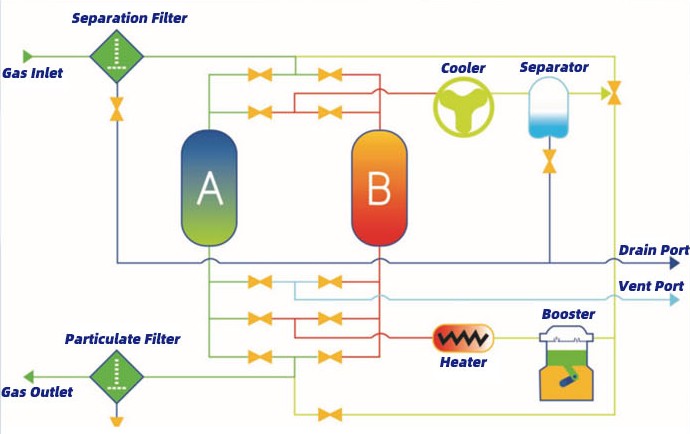
The Yipu Urban Gas Pipeline Dehydration Unit is usually installed in urban gate stations or regional pressure regulating stations, upstream of downstream pressure regulation and metering units and after upstream filters. The process is as follows:
- Inlet Gas PreprocessingNatural gas from long-distance pipelines (pressure typically 1.6-4.0MPa or higher) first enters the unit. It works in conjunction with existing on-site filters to further remove fine dust and liquid droplets, providing clean gas source for deep dehydration.
- Dual-Tower Adsorption Deep Dehydration (Core Process)
- Adsorption Stage: Preprocessed gas enters an adsorption tower filled with 3A/4A molecular sieves (preferred). With its large specific surface area and strong polarity, the molecular sieve selectively and efficiently adsorbs water molecules, achieving deep gas drying. This process effectively protects subsequent regulators and metering instruments.
- Automatic Switching and Continuous Gas Supply: Before the working tower reaches adsorption saturation (single tower continuous operation for 12-48 hours, flexibly adjustable according to gas quality conditions), the system automatically switches to the standby tower that has completed regeneration via PLC, ensuring uninterrupted supply of dry gas to the urban pipeline network.
- Regeneration and Cooling Cycle
- Heating Regeneration: The saturated tower undergoes regeneration. The system adopts an energy-efficient closed-loop regeneration method: a small portion of ultra-dry gas produced by the unit is extracted, heated to 150-180℃ via a heater, and then passed through the adsorption tower in reverse to completely desorb moisture adsorbed deep within the molecular sieve.
- Cooling: After regeneration, the high-temperature adsorption tower is cooled with cooled gas (via air cooling or water cooling; air cooling is more suitable for unattended stations) to restore it to the appropriate adsorption temperature, preparing for the next working cycle.
- Dry Gas Delivery to Urban Pipeline NetworkAfter deep dehydration, the atmospheric pressure dew point of the gas can stably reach -55℃ to -70℃, far lower than the minimum ambient temperature in winter in any region, fundamentally eliminating the possibility of ice blockage. The dry gas then passes through an outlet filter (precision ≤3μm) for dust protection before entering downstream pressure regulation and metering units, and finally being injected into the urban medium-pressure pipeline network.
III. Working Principle
The core technical principle of the unit is pressure swing adsorption (PSA) combined with molecular sieve selective adsorption.
- Selective Adsorption: The pore size of 3A molecular sieve (approximately 3 angstroms) only allows smaller water molecules (2.8 angstroms) to enter and be strongly adsorbed, while effectively excluding hydrocarbon molecules such as methane and ethane. This specificity ensures maximum dehydration efficiency, avoids molecular sieve “poisoning” and regeneration difficulties caused by heavy hydrocarbon adsorption, and guarantees long-term stable operation of the unit in the urban gas sector.
- Pressure Swing Adsorption: The unit performs adsorption under relatively high pressure (0.1-8.0MPa, perfectly covering gate station pressure) and regeneration under lower pressure (and high temperature). Utilizing the characteristic of molecular sieves having high adsorption capacity under high pressure and low adsorption capacity under low pressure and high temperature, the system realizes the cycle of adsorption and regeneration through periodic pressure and temperature changes, thereby continuously producing ultra-dry gas.
IV. Core Advantages
- Eliminate Ice Blockage, Ensure Winter Supply SafetyWith an outlet dew point of ≤-70℃, the unit ensures no liquid water or hydrates form in pressure regulating stations and pipelines under any severe cold conditions, serving as a “reassurance” for stable urban gas supply in winter.
- Protect Pipeline Safety, Extend Infrastructure LifespanDeep dehydration fundamentally cuts off the path of internal pipeline corrosion, significantly reduces leakage risks, protects valuable pipeline assets, and extends their service life by decades.
- Accurate Metering, Recover Trade LossesProvides clean, dry gas source for trade metering instruments, ensuring accurate measurement and helping gas companies recover long-term economic losses caused by inaccurate metering.
- Fully Automatic Intelligent Operation, Empower Smart GasBased on PLC full-automatic control, it realizes unattended operation, automatic fault alarm, and supports remote diagnosis and maintenance. It perfectly aligns with the management trend of “intelligence and minimal staffing” for urban gate stations, greatly improving operational efficiency.
- Energy Efficient and Economical Operation
- Closed-loop regeneration technology minimizes product gas loss as regeneration gas, resulting in significant long-term economic benefits for large-flow urban gas.
- Low inlet and outlet pressure drop (≤50kPa) reduces energy consumption for pipeline transportation.
V. Technical Strength
- Tailor-Made for Urban GasThe design fully considers the spatial layout, pressure level, and O&M mode of gate stations/pressure regulating stations, featuring a compact structure and user-friendly operation interface.
- Excellent Pressure AdaptabilityThe wide working pressure range of 0.1 to 8.0MPa enables seamless integration into various urban gate stations from sub-high pressure to high pressure, with strong adaptability.
- Application of Core Material SciencePreferred 3A molecular sieve dedicated to deep natural gas dehydration, featuring high adsorption capacity, high crush strength, and long service life.
- Strict Quality and Safety StandardsAvailable mechanical test reports, Exd Ⅱ BT4 explosion-proof rating, and IP54/IP65 protection rating ensure absolute reliability of the equipment in urban gas applications related to public safety.
- Modular Design and Rapid DeploymentSerialized flow and size design allow flexible configuration or expansion according to the growth of urban gas demand, supporting rapid installation and commissioning.
VI. Product Introduction
- Product Category: Urban Pipeline Natural Gas Dehydration Unit
- Brand: Yipu
- Core Components: Adsorption towers, 3A/4A molecular sieves, regeneration gas heater, PLC electrical control system, switching valve group
- Working Mode: Dual-tower/multi-tower alternation, continuous cycle operation
- Control Mode: PLC programmable controller, fully automatic control with fault alarm
- Place of Origin: Zhejiang, China
This unit is a core preprocessing equipment to ensure the safe, stable, and efficient operation of urban gas pipelines, and an indispensable key component of modern smart gate stations.
VII. Application Scenarios
- Core Applications: Deep dehydration of natural gas in urban receiving gate stations, high-medium pressure regulating stations, and transmission and distribution stations.
- Pre-Application: Pre-deep dehydration in urban gate stations supplying gas to CNG mother stations and LNG liquefaction plants.
- Special Applications: Gas dehydration in pressure regulation and metering stations dedicated to large industrial users and power plants.
VIII. Key Technical Indicators
| Indicator Category | Parameter Details | Technical & Market Significance |
|---|---|---|
| Processing Capacity | 500 ~ 20,000 Nm³/h | Covers requirements from regional pressure regulating stations to major urban gate stations |
| Working Pressure | 0.1 ~ 8.0 MPa | Core advantage, perfectly matching urban gate station pressure conditions |
| Outlet Dew Point | ≤ -55℃ ~ -70℃ | Lifeline indicator, completely eliminating ice blockage and corrosion problems |
| Adsorbent | 3A/4A Molecular Sieve | Technical key, high specificity, long service life, suitable for urban gas |
| Continuous Operation Time | 12 ~ 48 h/tower | Long-cycle operation, reducing maintenance frequency, stable and reliable |
| Regeneration Time | ≤ 8 h | Rapid regeneration, ensuring timely system standby |
| Control & Automation | PLC, Fully Automatic, Fault Alarm | Cornerstone of smart gas, enabling unattended operation and remote O&M |
| Energy Consumption & Yield | Closed-loop regeneration, low pressure drop | Economic guarantee, reducing gas consumption and operational costs |
| Safety Certification | Explosion-proof: EXD Ⅱ BT4; Protection: IP54/IP65 | Safety baseline, meeting strict specifications for high-risk urban areas |
Technical Parameter Sheet of Urban Gas Pipeline Dehydration Unit
| Item | Specification | Item | Specification |
|---|---|---|---|
| Product Category | Urban Gas Pipeline Dehydration Unit | Working Medium | Oilfield Associated Gas, Shale Gas, Natural Gas, Coalbed Methane, Biogas |
| Brand | Yipu | Place of Origin | Zhejiang, China |
| Working Flow Rate | 500~20,000 Nm³/h | Core Components | Motor, Compressor, Adsorption Tower, Molecular Sieve, Filter, Booster, Cooler, Separator, Heater, Control Valve & Control System |
| Core Advantages | Stable & Efficient Operation, Fully Automatic, Energy-Saving & Environmentally Friendly, Remote Maintenance | Application Scenarios | Shale Gas & Wellhead Gas Drying/Dehydration, Urban Pipeline Natural Gas Dehydration, Oilfield Associated Gas & Coalbed Methane Drying/Dehydration, Biogas Drying/Dehydration |
| Mechanical Test Report | Available | Factory Inspection Video | Available |
| Working Pressure | 0.1~8.0 Mpa | Inlet Temperature | 0~40℃ (50℃) |
| Inlet Pressure Dew Point | 0.6 Mpa/-13℃/Saturated with Water | Single Tower Continuous Working Time | 12~48 h |
| System Design Pressure | 1.0~9.0 Mpa | Regeneration Time | ≤8 h (10 h) |
| Adsorbent | 3A/4A Molecular Sieve | Outlet Atmospheric Dew Point | ≤-55℃~-70℃ |
| Regeneration Cooling Method | Air Cooling/Water Cooling | Outlet Filtration Precision | ≤3 μm |
| Power Supply/Power | 380V/50Hz/12.30~150 kW | Protection Class | IP54 or IP65 |
| Inlet & Outlet Pressure Drop | ≤50 kPa | Motor Explosion-Proof Class | ExdⅡ BT4 |
| Noise Level | ≤85 dB | Regeneration Gas Heating Temperature | 150~180℃ |
| Overall Dimensions | L: (2500~8000) mmW: (1600~3000) mmH: (2350~2850) mm | Equipment Weight | 2000~7000 kg |
| Working Method | “Dual-Tower/Multi-Tower Alternating Adsorption-Regeneration,Continuous Gas Supply” | Regeneration Method | “Closed/Open Loop, Depressurization/IsobaricRegeneration/Heated Regeneration” |
| Control Mode | “PLC Programmable Controller, Digital Temperature ControlInstruments, Automatic Fault Alarm” | Switching Mode | Manual/Automatic |
Packaging, Shipping Information & Quotation
| Item | Specification |
|---|---|
| Sales Unit | Single Unit/Set |
| Individual Packaging Dimensions | 250020002850 (LWH) mm |
| Individual Product Gross Weight | 3000 kg |
| Packaging Method | Wooden Case/Triple-Proof Cloth (Waterproof, Mildewproof, Corrosion-Resistant) |
| Quotation | $28,000 ~ $100,000 |