
Micro-Heat Adsorption Dryer

Overview Through innovative micro-thermal regeneration technology, Yipu Micro-Thermal Regenerative Adsorption Dryer delivers three core values to users: This product is particularly suitable for enterprises with high compressed air quality requirements, moderate air consumption, and a focus on comprehensive operating costs. It serves as an ideal upgrade and replacement for traditional heatless and heated regenerative equipment….
Overview
Through innovative micro-thermal regeneration technology, Yipu Micro-Thermal Regenerative Adsorption Dryer delivers three core values to users:
- Optimal Comprehensive Energy Efficiency: Achieves the perfect balance between regeneration air consumption and electrical energy consumption, reducing annual operating costs by 25%-40% compared to heatless regenerative dryers.
- High Equipment Reliability: Long-cycle design significantly reduces valve operation frequency, extending the service life of key components by over 50%.
- Superior Drying Quality: Stable low dew point output ensures process quality, with multiple dew point grades meeting different precision requirements.
This product is particularly suitable for enterprises with high compressed air quality requirements, moderate air consumption, and a focus on comprehensive operating costs. It serves as an ideal upgrade and replacement for traditional heatless and heated regenerative equipment.
I. Market Pain Points
- Difficulty in Balancing Energy Consumption and Performance
- Heatless regenerative equipment has high air consumption (20%-25%) and high operating costs.
- Although heated regenerative equipment has low air consumption, it consumes enormous electrical energy for heating.
- Users face a difficult trade-off between drying performance and operating costs.
- Equipment Reliability Issues
- Heatless regenerative equipment requires frequent switching (10-minute cycles), leading to severe valve wear.
- Long-term frequent switching increases equipment failure rates and maintenance costs.
- Insufficient Dew Point Stability
- Conventional drying equipment exhibits unstable dew points when load fluctuates.
- This affects the consistency of precision production process quality.
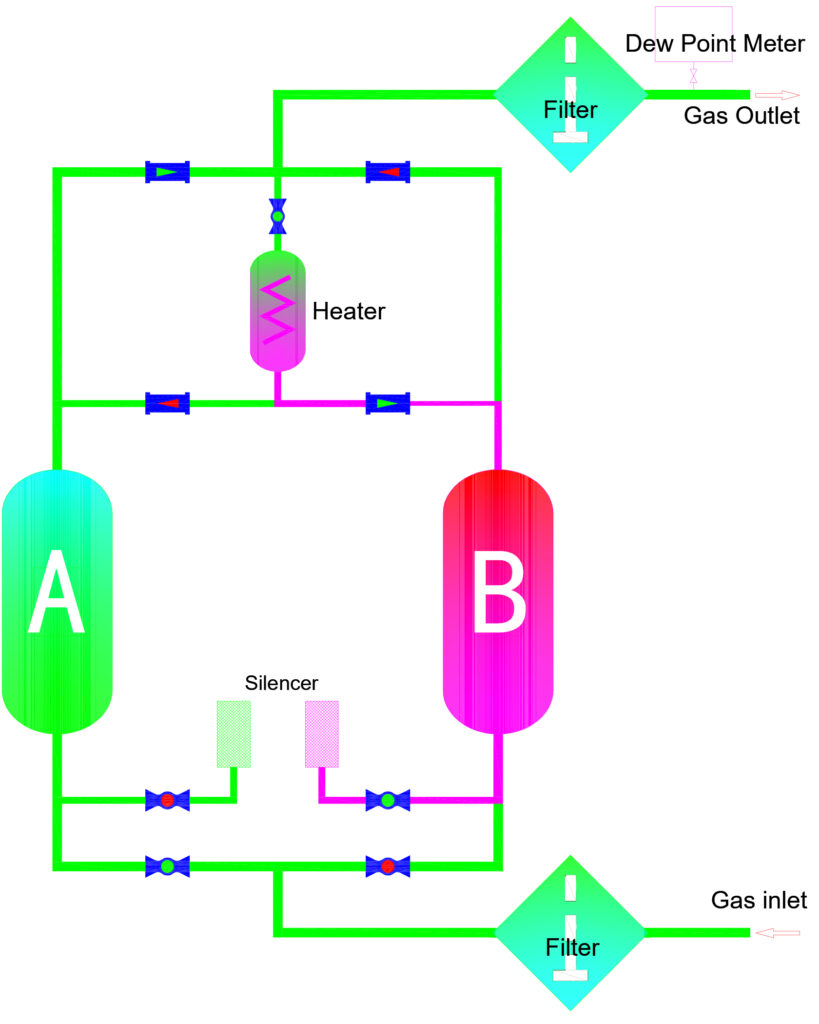
II. System Process Flow
Four-Process Cycle System:
- Adsorption Drying Process
- Compressed air (0.6-1.0MPa, ≤45℃) enters Adsorption Tower A.
- Activated alumina or molecular sieve deeply adsorbs moisture.
- Dry air with a pressure dew point of -20℃ to -70℃ is produced.
- Heated Regeneration Process
- Approximately 7-10% of the dry air is heated by an electric heater.
- Hot air (about 150-180℃) enters Tower B to deeply regenerate the adsorbent.
- Moisture inside the adsorbent is completely removed.
- Cold Purge Cooling Process
- Heating is stopped, and the regenerated tower is purged with normal-temperature dry air.
- The adsorbent temperature is reduced to the operating temperature range.
- Ensures adsorption performance for the next cycle.
- Pressure Equalization and Switching Process
- At the end of the 2-6 hour cycle, pressure equalization is performed between the two towers.
- The microcomputer control system automatically switches operating states.
III. Technical Principle
Micro-Thermal Regeneration Mechanism:
- Uses a small amount of thermal energy to significantly reduce regeneration air consumption.
- Heating temperature is controlled within the optimal regeneration temperature range of the adsorbent.
- Balances the economy of thermal energy input and compressed air consumption.
Intelligent Control Strategy:
- Automatically optimizes cycle time based on inlet conditions and dew point requirements.
- Heating power is automatically adjusted according to ambient temperature.
- Achieves optimal balance control between energy consumption and drying performance.
IV. Core Competitive Advantages
- Outstanding Energy-Saving Effect
- Regeneration air consumption: 7%-16%, 30%-60% lower than heatless regenerative dryers.
- Long-cycle design (2-6 hours) minimizes equipment wear and extends service life.
- Stable Low Dew Point Output
- Pressure dew point can reach -70℃, meeting high-end application requirements.
- Combination of activated alumina and molecular sieve ensures deep drying.
- Intelligent Operation Management
- Fully automatic microcomputer control realizes optimal energy efficiency operation.
- Fault self-diagnosis system facilitates convenient maintenance.
- Flexible Application Configuration
- Three dew point grades available to adapt to different process requirements.
- Wide processing capacity range (1.2-110 Nm³/min) covers various scales.
V. Technical Strength
Core Technical Advantages:
- Micro-thermal regeneration process parameter optimization technology.
- Adsorbent composite formula and filling process.
- Intelligent temperature control and energy consumption management algorithm.
Manufacturing Process Guarantee:
- Design and manufacturing of high-efficiency electric heaters.
- Control of air distribution uniformity in adsorption towers.
- Strict airtightness and performance testing.
VI. Product Series Introduction
Standard Series Configuration:
- WH-20 Series: 1.2-20 Nm³/min, Weight: 120-800 kg
- WH-50 Series: 25-50 Nm³/min, Weight: 850-1800 kg
- WH-80 Series: 55-80 Nm³/min, Weight: 1900-3000 kg
- WH-110 Series: 85-110 Nm³/min, Weight: 3200-4200 kg
Dew Point Grade Configuration:
- Economic Type: -20℃ Pressure Dew Point (Activated Alumina)
- Standard Type: -40℃ Pressure Dew Point (Activated Alumina)
- Deep Drying Type: -70℃ Pressure Dew Point (Activated Alumina + 5A Molecular Sieve Composite)
VII. Application Scenarios
High-End Manufacturing:
- Automotive Manufacturing: Spraying robots, precision assembly.
- Electronic Semiconductors: Chip manufacturing, LCD panels.
- Medical Equipment: Instruments and meters, production equipment.
Chemical Production:
- Catalyst protection, reaction gases.
Food and Beverage:
- Aseptic packaging, fermentation processes.
Pharmaceutical Industry:
- Cleanrooms, process air supply.
Special Demand Occasions:
- Laboratories with strict dew point requirements, long-distance pipeline transmission systems, high-precision instrument air supply.
VIII. Detailed Technical Specifications
Yipu Micro-Thermal Regenerative Adsorption Dryer Technical Parameter Sheet
| Parameter Category | Technical Indicators | Remarks |
|---|---|---|
| Operating Conditions | ||
| Inlet Air Temperature | ≤45℃ | Maximum allowable inlet temperature |
| Working Pressure | 0.6-1.0 MPa | Standard working pressure range |
| Inlet Oil Content | ≤0.01 PPM | Pre-installed precision filter required |
| Performance Indicators | ||
| Pressure Dew Point | -20℃, -40℃, -70℃ | Three dew point grades available |
| Regeneration Air Consumption | 7%~16% | Significantly lower than heatless regenerative dryers |
| Pressure Loss | ≤3% of inlet pressure | Low system resistance design |
| Air Processing Capacity | 1.2~110 Nm³/min | Wide-range processing capacity |
| Technical Configuration | ||
| Desiccant | Activated Alumina (Low Dew Point Model: Activated Alumina + 5A Molecular Sieve Composite) | Two configurations available |
| Regeneration Method | Micro-Thermal Regeneration | Energy-saving regeneration method |
| Working Method | Dual-Tower Alternating Continuous Operation | Ensures continuous and stable air supply |
| Working Cycle | T=2~6 hours | Adjustable long-cycle design |
| Control Mode | Microcomputer Automatic Control | Intelligent operation control |
| Installation Method | Indoor flat ground, foundation-free installation | Simple and quick installation |
| Electrical Parameters | ||
| Power Supply Voltage | 380V/50HZ | Industrial standard power supply |
| Compressor Power | 3~27 Hp | Configured according to processing capacity |
| Fan Power | 180W~300W×8 | High-efficiency heat dissipation system |
| Structural Parameters | ||
| Air Inlet/Outlet Diameter | Rc1″~DN150 | Multiple interface specifications available |
| Equipment Weight | 120~4200 kg | Determined by model |
| Overall Dimensions (L×W×H) | (800-2700)×(418-1100)×(1548-2850) mm | Compact design |