
Heatless Regenerative Adsorption Dryer

Overview Through a concise and efficient design, Yipu Heatless Regenerative Adsorption Dryer delivers three core values to users: This product is particularly suitable for small and medium-sized manufacturing enterprises with low air consumption, limited budgets, and weak maintenance capabilities, serving as a cost-effective compressed air drying solution. I. Market Pain Point Analysis II. System Process…
Overview
Through a concise and efficient design, Yipu Heatless Regenerative Adsorption Dryer delivers three core values to users:
- Outstanding Economy: Low equipment investment cost, suitable for budget-constrained users; simple maintenance and low total lifecycle cost.
- Wide Applicability: Suitable models available for small workshops to medium-sized factories; ideal for special working conditions without external heat sources, featuring high reliability.
- High Stability: No heating elements, resulting in low failure rate; microcomputer-controlled for stable and reliable operation.
This product is particularly suitable for small and medium-sized manufacturing enterprises with low air consumption, limited budgets, and weak maintenance capabilities, serving as a cost-effective compressed air drying solution.
I. Market Pain Point Analysis
- Pressure of Equipment Investment Cost
- Heated regenerative equipment requires a heating system, leading to high initial investment.
- Small enterprises with limited budgets need economical and practical drying solutions.
- Installation Space Constraints
- Traditional large-scale drying equipment occupies a large area, making it unsuitable for factories with limited space.
- Foundation-free installation is required to reduce construction complexity and costs.
- Demand for Simple Operation and Maintenance
- Complex equipment requires professional technicians for maintenance.
- Small and medium-sized enterprises lack professional maintenance teams and need user-friendly “plug-and-play” equipment.
- Energy-Sensitive Applications
- No external heat source available for heated regenerative equipment.
- Application scenarios sensitive to power consumption.
II. System Process Flow
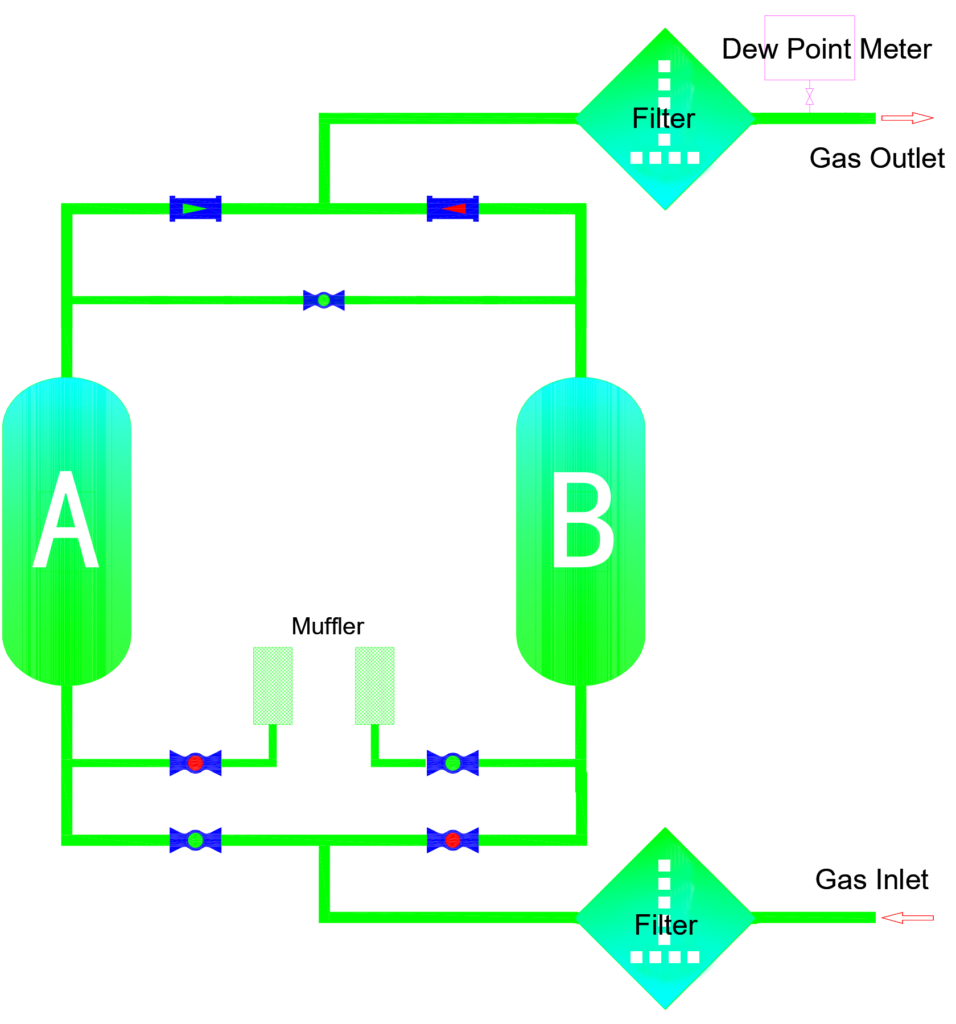
Dual-Tower Rapid Cycle System:
- Adsorption Drying Stage
- Compressed air (0.6-1.0MPa, ≤45℃) enters Adsorption Tower A.
- Passing through an activated alumina or molecular sieve bed, moisture is adsorbed via capillary action.
- Dry air with a pressure dew point of -20℃ or -40℃ is produced.
- Regeneration and Desorption Stage
- Approximately 12-15% of the dry finished air enters Tower B after pressure reduction.
- Low-pressure air purges and regenerates the saturated adsorbent.
- Desorbed moisture is discharged from the system along with the regeneration airflow.
- Pressure Equalization and Switching Stage
- At the end of the 10-minute cycle, pressure equalization is performed between the two towers.
- The microcomputer control system automatically switches valves, and the roles of the towers are swapped.
Continuous Working Mode:
- Tower A: Adsorption (8 minutes) → Pressure Equalization (1 minute) → Regeneration (1 minute)
- Tower B: Regeneration (8 minutes) → Pressure Equalization (1 minute) → Adsorption (1 minute)
III. Technical Principle
Adsorption Mechanism:
- Utilizes the large specific surface area of activated alumina (300-400m²/g).
- Capillary action adsorbs water molecules into the microporous structure.
- Strong selective adsorption of water molecules (2.8Å) by 5A molecular sieve (pore size 5Å).
Regeneration Principle:
- Reduces partial pressure to break the adsorption equilibrium (Pressure Swing Adsorption, PSA).
- Dry purge gas carries away desorbed water molecules.
- Regeneration is achieved through pressure changes without external heat.
IV. Core Advantages
- Simple and Reliable Structure
- No heating elements, minimizing potential failure points.
- Symmetrical dual-tower design for easy maintenance.
- Low Investment Cost
- No heating system required, reducing manufacturing costs.
- Foundation-free installation saves installation expenses.
- Easy Operation and Maintenance
- Fully automatic microcomputer control, no dedicated personnel required.
- Modular design enables simple and quick maintenance.
- Rapid Start-Stop Response
- 10-minute short cycle allows quick achievement of working status.
- Suitable for intermittent production conditions.
V. Technical Strength
Core Technologies:
- Activated alumina and molecular sieve composite bed technology.
- Rapid switching valve control technology.
- Uniform air distribution design technology.
Manufacturing Processes:
- Precision valve manufacturing ensures reliable switching in 10-minute cycles.
- Anti-pulverization adsorbent filling process.
- Compact structure optimization design.
VI. Product Series Introduction
Standard Series:
- WH-10 Series: 1.2-10 Nm³/min, Weight: 110-400 kg
- WH-30 Series: 12-30 Nm³/min, Weight: 450-1200 kg
- WH-50 Series: 35-50 Nm³/min, Weight: 1300-1800 kg
- WH-65 Series: 55-65 Nm³/min, Weight: 2000-2500 kg
Dew Point Grades:
- Standard Type: -20℃ Pressure Dew Point (Activated Alumina)
- Low Dew Point Type: -40℃ Pressure Dew Point (Activated Alumina + 5A Molecular Sieve Composite)
VII. Application Scenarios
General Industrial Fields:
- Pneumatic tools, packaging machinery, filling equipment, and component cleaning/drying in small manufacturing workshops.
Specific Industry Applications:
- Laboratory instruments and equipment, small spraying equipment, pneumatic conveying systems.
Special Working Conditions:
- Occasions without external power supply (with supporting power generation equipment), explosion-proof environments (no electrical heating elements), supporting mobile air compressor units.
VIII. Detailed Technical Specifications
Yipu Heatless Regenerative Adsorption Dryer Technical Parameter Sheet
| Parameter Category | Technical Indicators | Remarks |
|---|---|---|
| Basic Performance Parameters | ||
| Air Processing Capacity | 1.2-65 Nm³/min | Standard condition flow rate |
| Working Pressure | 0.6-1.0 MPa | Operates normally within this pressure range |
| Pressure Dew Point | -20℃, -40℃ | Two dew point grades available |
| Regeneration Air Consumption | 20%~25% | Proportion of finished air consumption |
| Pressure Loss | ≤3% of inlet pressure | System resistance loss |
| Operating Conditions | ||
| Inlet Air Temperature | ≤45°C | Maximum allowable inlet temperature |
| Inlet Oil Content | ≤0.01 PPM | Pre-installed precision filter required |
| Technical Configuration | ||
| Desiccant | Activated Alumina (Low Dew Point Model: Activated Alumina + 5A Molecular Sieve Composite) | Two adsorbent configurations available |
| Regeneration Method | Heatless Regeneration | Based on Pressure Swing Adsorption (PSA) principle |
| Working Method | Dual-Tower Alternating Continuous Operation | Ensures continuous air supply |
| Working Cycle | T=10 minutes | Rapid cycle regeneration |
| Control Mode | Microcomputer Automatic Control | Intelligent operation |
| Installation Method | Indoor flat ground, foundation-free installation | Simple and quick installation |
| Utility Requirements | ||
| Power Supply | 220V/50HZ | Standard civil power supply |
| Structural Parameters | ||
| Equipment Weight | 110-2500 kg | Determined by processing capacity |
| Overall Dimensions (L×W×H) | (800-2150)×(400-850)×(1500-3000) mm | Compact design |