
Modular Dryer


Overview Yipu Combined Compressed Air Dryer innovatively integrates refrigerated and adsorption drying technologies. It first efficiently removes most moisture through a refrigerated dryer, then achieves deep drying to a dew point of -40℃/-70℃ via an adsorption dryer, boasting dual advantages of low dew point and low energy consumption. Its unique heat recovery system significantly reduces…
Overview
Yipu Combined Compressed Air Dryer innovatively integrates refrigerated and adsorption drying technologies. It first efficiently removes most moisture through a refrigerated dryer, then achieves deep drying to a dew point of -40℃/-70℃ via an adsorption dryer, boasting dual advantages of low dew point and low energy consumption. Its unique heat recovery system significantly reduces regeneration air consumption (only 6%~12%) and energy usage, addressing the high-cost pain point of traditional equipment. Featuring intelligent control and easy installation, it provides efficient and energy-saving solutions for industries requiring high-quality dry air, such as electronics, pharmaceuticals, and spraying.
I. Market Pain Points
In the field of compressed air purification, users have long faced a dilemma:
- Refrigerated Dryers Fail to Meet Deep Drying RequirementsLimited by refrigeration principles, traditional refrigerated dryers typically only achieve a pressure dew point above +2℃. For industries requiring ultra-dry air (e.g., precision instruments, spraying, electronics, pharmaceuticals, high-end manufacturing), this dew point is far from sufficient, posing risks of condensation-induced equipment corrosion and compromised product quality.
- High Operating Costs of Adsorption DryersWhile traditional adsorption dryers can reach extremely low dew points of -20℃, -40℃, or even -70℃, their regeneration process consumes large amounts of finished compressed air (heatless regeneration air consumption up to 12%-15%) or additional electrical energy (micro-thermal regeneration), resulting in significant energy waste and substantially increasing users’ long-term operational costs.
- Low Energy Efficiency of Single EquipmentWhether using a refrigerated dryer or adsorption dryer alone to handle the entire process from high temperature/humidity to low dew point, there is a problem of “overcapacity” or insufficient energy utilization, leading to low overall system energy efficiency.
Value Proposition of Yipu Combined Dryer
To address the above pain points, it emerged as the optimal solution. Through the intelligent combination of “refrigerated drying + adsorption drying”, it achieves the perfect unification of “low dew point” and “low energy consumption”, providing users with a solution that balances outstanding performance and economic efficiency.
II. System Process
The combined dryer is an integrated system with an exquisite internal flow design, as follows:
Pre-Cooling and Initial Dehumidification
- High-temperature and high-humidity compressed air discharged from the air compressor (inlet temperature ≤45℃) first enters the heat exchanger, exchanging heat with the low-temperature dry finished air from the adsorption tank to achieve preliminary cooling.
- The pre-cooled air enters the evaporator and is forced cooled to approximately 2℃ by the refrigeration system. At this point, most water vapor in the air condenses into liquid water, which is discharged from the system through an automatic drain valve. Over 80% of the moisture load is removed in this stage.
Deep Adsorption Drying
- After refrigerated drying, the compressed air with significantly reduced humidity enters the adsorption tank filled with high-performance desiccants (e.g., alumina, molecular sieve).
- As the air flows through the desiccant, residual water vapor is deeply adsorbed, ultimately producing stable low-dew-point finished air (up to -40℃ or -70℃).
Energy Recovery and Regeneration
- The low-temperature dry finished air from the adsorption tank returns to the initial heat exchanger to cool the incoming high-temperature and high-humidity air, recovering cold energy. This process not only reduces the load on the front-end refrigerated dryer but also raises the temperature of the finished air itself, preventing condensation on the outer wall of the transmission pipeline.
- A small portion of the heated finished air (regeneration air consumption only 6%~12%) is extracted to regenerate the desiccant in the other adsorption tank that has completed adsorption (purging adsorbed moisture) and restore its drying capacity. Since the regeneration air source is pre-dried and at an appropriate temperature, regeneration efficiency is extremely high, with air consumption far lower than that of traditional adsorption dryers.
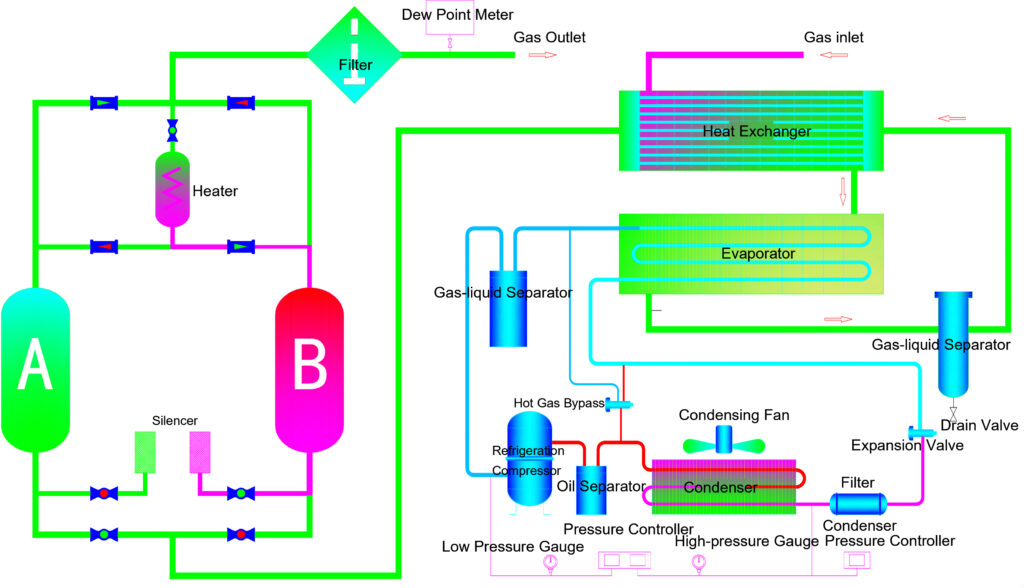
III. Working Principle
The core working principle of Yipu Combined Dryer is “graded treatment and cascade energy utilization”.
First Stage: Refrigerated Drying (Mechanical Dehumidification)
Using refrigeration technology, the air temperature is reduced below the dew point to condense and separate water vapor. This stage efficiently handles most “explicit” moisture in the air, bearing the main dehumidification load.
Second Stage: Adsorption Drying (Physical-Chemical Dehumidification)
Utilizing the large specific surface area and strong adsorption capacity of porous solid desiccants, trace residual water vapor in the air is deeply removed. This stage specifically targets “implicit” moisture to ensure an extremely low pressure dew point.
Energy Coupling Technology
The two drying stages are organically coupled through a heat exchanger, realizing efficient cyclic utilization of internal system energy. The cold energy of the finished air pre-cools the inlet air, reducing the energy consumption of the first stage; the heated finished air is used for regeneration, improving the efficiency of the second stage. The entire system forms an efficient and energy-saving organic whole.
IV. Core Advantages
- Outstanding Energy Efficiency
- Dual low energy consumption: The front-end refrigerated dryer bears most of the load with high operational efficiency; the back-end adsorption dryer has significantly reduced regeneration air consumption (6%~12%) due to the low inlet moisture load. The comprehensive energy consumption is 30%~50% lower than using an adsorption dryer alone.
- Extremely Low Dew Point and High Stability
- Stably produces a pressure dew point of -40℃ or -70℃, meeting the most demanding industrial requirements. The two-stage drying provides mutual guarantee, ensuring stable and reliable dew point output.
- Reduced Comprehensive Costs
- Initial investment: Compared to configuring a large-capacity adsorption dryer alone, the combined solution allows for a smaller adsorption tank design when meeting the same dew point requirements, resulting in a more favorable initial equipment investment.
- Operational costs: Extremely low energy consumption and air consumption directly translate to long-term electricity savings.
- Maintenance costs: The front-end refrigerated dryer removes most moisture and part of the oil, reducing the burden on the adsorbent, extending its service life, and lowering replacement frequency and costs.
- Intelligent Control
- Equipped with microcomputer automatic control, it real-time monitors operating parameters and automatically switches between adsorption and regeneration states, ensuring the equipment always operates under optimal conditions. It is easy to operate and requires no dedicated personnel on duty.
V. Technical Strength
- System Integration CapabilityNot a simple equipment assembly, but in-depth system integration and capacity matching design based on a profound understanding of refrigerated and adsorption technologies.
- High-Efficiency Heat Exchange TechnologyAdopts high-efficiency heat exchangers to maximize energy recovery efficiency, a key factor in achieving energy savings.
- Precise Capacity MatchingBased on user air volume, inlet conditions, and target dew point, accurately calculates and matches the capacities of the refrigeration unit and adsorption unit to ensure the system operates at the optimal economic point.
- Flexible Regeneration MethodsOffers two options: heatless regeneration (Model YPZ(W)D) and micro-thermal regeneration (Model YPZ(V)D), allowing users to flexibly configure according to their own energy conditions and cost considerations.
- Wide AdaptabilityThe product line covers a broad air volume range of 1.2 to 510 Nm³/min, supports water cooling/air cooling, and a pressure range of 0.6-1.0MPa, meeting most industrial application scenarios.
VI. Product Introduction
Yipu Combined Low Dew Point Compressed Air Dryer is an efficient and energy-saving purification equipment integrating dual technologies of refrigerated drying and adsorption drying. Through intelligent pipeline connection and optimized system design, it maximizes the advantages of the two traditional drying technologies while avoiding their respective shortcomings.
- Product Series: Covers all needs from small workshops to large factories, with air volume ranging from 1.2 to 510 Nm³/min.
- Core Configuration: Includes heat exchanger, evaporator (refrigeration system), dual adsorption tanks, intelligent control system, regeneration system (heater or blower), etc.
- Design Features: Compact structure, installed on indoor flat ground without the need for a foundation, greatly simplifying installation engineering. Professional appearance design with complete interfaces (air interfaces from RP1″ to DN300, water cooling interfaces from RC1″ to RC3″*2).
VII. Application Scenarios
The equipment is particularly suitable for industries with dual high requirements for compressed air dew point and operating costs:
- High-End Manufacturing: Automotive spraying, precision instruments, robots, CNC machine tools.
- Electronics and Semiconductor Industry: Chip manufacturing, PCB (Printed Circuit Board), LCD panels.
- Pharmaceutical and Bioengineering: Aseptic production lines, fermentation processes, pharmaceutical packaging.
- Chemical and Plastic Industry: Powder conveying, PET bottle blowing, special chemical synthesis.
- Food and Beverage Industry: Nitrogen-filled packaging for oxidizable foods, beverage filling.
- Others: Aerospace, laboratories, pneumatic control instruments, etc.
VIII. Main Technical Specifications
| Indicator Category | Parameter Details |
|---|---|
| Inlet Air Temperature | ≤ 45℃ |
| Working Pressure | 0.6 – 1.0 MPa |
| Pressure Dew Point | -40℃ or -70℃ (Customizable) |
| Regeneration Method | YPZ(W)D (Heatless Regeneration), YPZ(V)D (Micro-Thermal Regeneration) |
| Regeneration Air Consumption | 6% ~ 12% (Far lower than traditional adsorption dryers) |
| Pressure Loss | ≤ 3% of inlet pressure |
| Cooling Method | Water Cooling or Air Cooling |
| Control Mode | Microcomputer Automatic Control |
| Installation Method | Indoor flat ground, no foundation required |
| Air Processing Capacity | 1.2 – 510 Nm³/min (Wide coverage) |
| Power Supply Voltage | 220V/1Ph/50Hz; 380V/3Ph/50Hz (Customizable for export) |
| Compressor Power | 1 – 120 Hp |
| Heating Power | 3 – 162 KW (Micro-thermal regeneration models) |
| Fan Power | 90 – 200*2 W (Air-cooled models) |
| Equipment Weight | 360 – 25100 kg |
| Overall Dimensions (L×W×H) | (1020-12000)mm * (725-4760)mm * (1200-3000)mm |