
LNG Refueling Station Drying and Dehydration System


Yipu LNG Filling Station Drying & Dehydration System is a high-reliability, high-performance key equipment tailored for the LNG industry. Its outstanding deep dehydration capacity, exceptional operational reliability, intelligent control level, and excellent energy-saving design make it a core guarantee for ensuring the safe, stable, long-term, full-load, and efficient operation of LNG liquefaction plants, creating maximum…
Yipu LNG Filling Station Drying & Dehydration System is a high-reliability, high-performance key equipment tailored for the LNG industry. Its outstanding deep dehydration capacity, exceptional operational reliability, intelligent control level, and excellent energy-saving design make it a core guarantee for ensuring the safe, stable, long-term, full-load, and efficient operation of LNG liquefaction plants, creating maximum economic value for customers.
I. Market Pain Points
In the production process of LNG (Liquefied Natural Gas) filling stations, deep dehydration of feed gas is a crucial and highly demanding link. This system precisely addresses the core pain points in LNG production:
- Preventing Low-Temperature Ice Blockage and Equipment Damage: This is the most critical pain point. In the low-temperature heat exchanger of the liquefaction process (temperature as low as -160℃), any trace of moisture will condense into ice, quickly blocking narrow flow channels, leading to a sharp drop in heat exchange efficiency and a surge in pressure drop. Eventually, the entire liquefaction plant is forced to shut down, resulting in extremely high maintenance costs.
- Ensuring LNG Product Quality and Safety: Moisture is a strictly restricted component in LNG. LNG with excessive water content can cause component segregation during storage and transportation, affecting its combustion performance. More importantly, ice shedding during subsequent gasification may pose potential safety hazards.
- Meeting Stringent Liquefaction Process Requirements: LNG liquefaction plants have extremely strict requirements for the dew point of feed gas (usually requiring a water dew point below -60℃ or even -70℃). Ordinary dehydration methods cannot meet these requirements, and deep dehydration is essential.
- Guaranteeing Continuous and Stable Operation: Filling stations or liquefaction plants need to operate 24/7. The dehydration system must continuously provide qualified dry gas. Any failure will cause the entire liquefaction production line to shut down, resulting in huge economic losses.
- Adapting to Gas Source Fluctuations: The gas source entering the filling station may come from urban pipeline networks, CNG tank trucks, or directly from pipelines. Its pressure and flow rate may fluctuate, requiring the dehydration system to have good working condition adaptability.
II. System Process
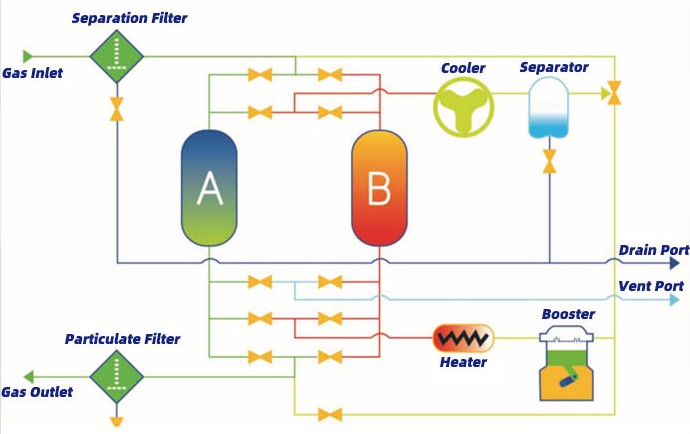
Yipu’s LNG Drying & Dehydration System adopts a mature and reliable dual-tower pressure swing adsorption process to ensure the continuous supply of ultra-dry gas to the liquefaction unit:
- Gas Inlet Pretreatment: Pipeline natural gas after pressure regulation and metering (pressure 0.1-8.0MPa, temperature 0-40℃) first enters the system and passes through a filter to remove solid particles and liquid droplets, protecting subsequent precision adsorbents.
- Dual-Tower Deep Adsorption Dehydration (Core Process):
- Adsorption Process: The pretreated gas enters the bottom of an adsorption tower filled with 3A molecular sieves. Under pressure, water molecules in the gas are selectively and efficiently adsorbed by the microporous structure of the molecular sieves, achieving deep drying.
- Automatic Switching and Continuous Gas Supply: When the adsorption of molecular sieves in the working tower is nearly saturated, the system automatically switches to the standby tower that has completed regeneration through PLC to continue working, realizing 24/7 uninterrupted gas supply to the liquefaction unit.
- Regeneration and Cooling Cycle:
- Heated Regeneration: The saturated adsorption tower is regenerated. The system adopts an efficient closed-cycle regeneration method, drawing a small portion of ultra-dry gas produced by the system itself, heating it to 150-180℃ through a heater, and passing it into the adsorption tower in the reverse direction. The high-temperature gas desorbs the moisture adsorbed deep in the molecular sieves.
- Cooling: After regeneration, the high-temperature adsorption tower needs to be cooled with cooled gas (via air cooling or water cooling) to restore it to a suitable adsorption temperature (usually 40-50℃), preparing for the next working cycle. The regenerated gas is cooled to separate and discharge liquid water.
- Ultra-Dry Gas Transmission to Liquefaction Unit: The gas after deep dehydration has a stable atmospheric pressure dew point of -55℃ to -70℃. It then passes through an outlet filter (precision ≤3μm) for dust protection, and finally obtains clean, ultra-dry qualified gas, which directly enters the liquefaction cold box for cryogenic liquefaction.
III. Working Principle
The core technical principle of this system is pressure swing adsorption and the shape-selective adsorption effect of molecular sieves.
- Shape-Selective Adsorption Effect: The pore size of 3A molecular sieves is about 3 angstroms, which only allows smaller water molecules (2.8 angstroms) to enter and be strongly adsorbed, while effectively excluding larger hydrocarbon molecules such as methane and ethane. This selectivity ensures the highest dehydration efficiency and avoids molecular sieve poisoning and regeneration difficulties caused by the adsorption of heavy hydrocarbons.
- Pressure Swing Adsorption: The system performs adsorption under relatively high pressure (0.1-8.0MPa) and regeneration under lower pressure (and high temperature). Utilizing the characteristic of molecular sieves having large adsorption capacity under high pressure and small adsorption capacity under low pressure and high temperature, a cycle of adsorption and regeneration is realized through periodic changes in pressure and temperature, thereby continuously producing ultra-dry gas.
IV. Core Advantages
- Extreme Deep Dehydration Capacity: The outlet dew point is ≤-70℃, far exceeding the strict requirements of the LNG liquefaction process. It fundamentally eliminates the risk of ice blockage during liquefaction and is the lifeline for ensuring the long-term stable operation of liquefaction plants.
- Absolute Operational Reliability: The dual-tower alternating, continuous gas supply working mode, combined with PLC full-automatic control, ensures uninterrupted dry gas supply to the liquefaction unit. The single-tower continuous working time of up to 48 hours proves its strong adsorption capacity and stability.
- Efficient Energy-Saving Design:
- Closed-cycle regeneration technology minimizes the loss of high-value product gas used as regenerated gas, improving the yield of the entire LNG plant.
- The inlet and outlet pressure drop as low as 50kPa reduces energy consumption in the pretreatment link.
- Wide Working Condition Adaptability: The wide working pressure range of 0.1 to 8.0MPa enables it to flexibly cope with incoming natural gas from different sources and with different gas qualities without additional pressure boosting or reducing adjustments.
- High Intelligence and Safety: Full-automatic operation, fault alarm, and remote maintenance functions greatly reduce manual operation intensity and operation and maintenance costs. The Exd Ⅱ BT4 explosion-proof rating and IP54/IP65 protection rating ensure absolute safety in the flammable and explosive environment of filling stations.
V. Technical Strength
- Precise Design for LNG Process: The system is specially designed for the harsh working conditions before LNG liquefaction, with a deep understanding and precise control of key points such as molecular sieve selection, regeneration temperature control, and dew point guarantee.
- Modular and Serialized Capabilities: Offers a wide flow range configuration from 500 to 20,000 Nm³/h, meeting the needs of different scales from small LNG skid-mounted stations to large liquefaction plants.
- Core Process Integration Expertise: Masters various regeneration and cooling process combinations such as “air cooling/water cooling” and “closed/open cycle”, and can provide the optimal and most economical solution according to the climate conditions and water resources of the project site.
- Strict Quality Assurance System: Available mechanical test reports and video factory inspections reflect the strict full-process quality control from raw materials, manufacturing to overall testing, ensuring that the industrial equipment delivered to customers is reliable and durable.
- Forward-Looking Intelligent Interfaces: The built-in PLC system and communication interfaces can be easily connected to the DCS or central control system of filling stations or liquefaction plants, realizing digital management and intelligent operation and maintenance.
VI. Product Introduction
- Product Category: LNG Filling Station Drying & Dehydration System
- Brand: Yipu
- Core Components: Adsorption tower, 3A/4A molecular sieve, regenerated gas heater, PLC electrical control system, cooling system
- Working Mode: Dual-tower/multi-tower alternation, continuous cyclic operation
- Control Method: PLC programmable controller full-automatic control, supporting manual operation
- Place of Origin: Zhejiang, China
This system is an indispensable key pretreatment equipment in the LNG liquefaction chain, and its performance directly determines the operational efficiency, stability, and economy of the main liquefaction unit.
VII. Application Scenarios
- Main Applications: Deep dehydration of feed gas before the liquefaction cold box in various LNG filling stations and liquefaction plants.
- Pre-Application: Can also be used in urban gate stations or pressure regulating stations supplying gas to LNG plants for pre-deep dehydration.
- Extended Applications: Similarly suitable for high-precision industries such as chemical, electronics, and air separation that require ultra-low dew point process gas.
VIII. Key Technical Indicators
| Indicator Category | Parameter Details | Technical and Market Significance |
|---|---|---|
| Processing Capacity | 500 ~ 20,000 Nm³/h | Covers the needs from small LNG skid-mounted stations to medium-sized liquefaction plants |
| Working Pressure | 0.1 ~ 8.0 MPa | Strong adaptability, can directly connect to pipeline network pressure without additional pressure regulation |
| Outlet Dew Point | ≤ -55℃ ~ -70℃ | Core performance indicator, meeting the harsh requirements of LNG liquefaction |
| Adsorbent | 3A Molecular Sieve | Technical key, specially designed for deep dehydration, resistant to hydrocarbon co-adsorption |
| Continuous Working Time | 12 ~ 48 h/tower | Long-cycle operation, reducing switching frequency, ensuring continuous and stable operation of the liquefaction line |
| Regeneration Time | ≤ 8 h | Rapid regeneration, ensuring timely system backup |
| Control and Automation | PLC, Full-Automatic, Fault Alarm | Realizes unattended operation and interlocking control with the main liquefaction unit |
| Energy Consumption and Yield | Closed-cycle regeneration, power 12.3~150kW | Reduces product gas loss, improves final LNG yield, and achieves economical operation |
| Safety Certification | Explosion-Proof: EXD Ⅱ BT4; Protection: IP54/IP65 | Meets the strict safety specifications of Class A explosion-proof areas in LNG plants |
LNG Filling Station Drying & Dehydration System – Technical Specification Sheet
| Item | Specification | Item | Specification |
|---|---|---|---|
| Product Category | LNG Filling Station Drying & Dehydration System | Working Medium | Oilfield Associated Gas, Shale Gas, Natural Gas, Coalbed Methane, Biogas |
| Brand | Yipu | Place of Origin | Zhejiang, China |
| Working Flow Rate | 500~20,000 Nm³/h | Core Components | Motor, Compressor, Adsorption Tower, Molecular Sieve, Filter, Booster, Cooler, Separator, Heater, Control Valve & Control System |
| Core Advantages | Stable & Efficient Operation, Full-Automatic Control, Energy-Saving & Environmental Protection, Remote Maintenance | Application Industries | LNG Mother Station & Filling Station, Urban Gas & Industrial Fuel, Power Generation Industry, Chemical & Fertilizer Industry |
| Mechanical Test Report | Available | Video Factory Inspection | Available |
| Working Pressure | 0.1~8.0 MPa | Inlet Temperature | 0~40℃ (50℃) |
| Inlet Pressure Dew Point | 0.6 MPa/-13℃/Water-Saturated | Single-Tower Continuous Working Time | 12~48 h |
| System Design Pressure | 1.0~9.0 MPa | Regeneration Time | ≤8 h (10 h) |
| Adsorbent | 3A/4A Molecular Sieve | Outlet Atmospheric Dew Point | ≤-55℃~-70℃ |
| Regeneration Cooling Method | Air Cooling/Water Cooling | Outlet Filtration Precision | ≤3 μm |
| Power Supply/Power | 380V/50Hz/12.30~150 kW | Protection Class | IP54 or IP65 |
| Inlet & Outlet Pressure Drop | ≤50 kPa | Motor Explosion-Proof Class | ExdⅡ BT4 |
| Noise Level | ≤85 dB | Regenerated Gas Heating Temperature | 150~180℃ |
| Overall Dimensions | L: (2500~8000) mmW: (1600~3000) mmH: (2350~2850) mm | Equipment Weight | 2000~7000 kg |
| Inlet & Outlet Pipe Diameter | DN50~DN200 | ||
| Working Mode | “Dual-Tower/Multi-Tower Alternating ‘Adsorption-Regeneration’Continuous Gas Supply” | Regeneration Method | “Closed/Open Cycle, Depressurization/IsobaricRegeneration/Heated Regeneration” |
| Control Method | “PLC Programmable Controller, Digital Temperature ControlInstrument, Automatic Fault Alarm” | Switching Mode | Manual/Automatic |
Packaging, Shipping & Quotation Information
| Item | Specification | Item | Specification |
|---|---|---|---|
| Sales Unit | Single Unit/Set | Individual Package Dimension | 2500×2000×2850 (L×W×H) mm |
| Individual Product Gross Weight | 3000 kg | Packaging Method | Wooden Case/Triple-Proof Cloth (Waterproof, Mildewproof, Corrosion-Proof) |
| Quotation | $28,000~$100,000 |