
Coalbed Methane Dehydration Unit


Overview Yipu Coalbed Methane (CBM) Dehydration Unit is an advanced equipment tailored to address the pain points in coalbed methane extraction. Its outstanding low-pressure adaptability, deep dehydration capacity, high automation level, and excellent energy-saving and environmental protection characteristics make it an ideal choice for improving the commercialization rate of coalbed methane, ensuring safe production, and…
Overview
Yipu Coalbed Methane (CBM) Dehydration Unit is an advanced equipment tailored to address the pain points in coalbed methane extraction. Its outstanding low-pressure adaptability, deep dehydration capacity, high automation level, and excellent energy-saving and environmental protection characteristics make it an ideal choice for improving the commercialization rate of coalbed methane, ensuring safe production, and reducing comprehensive operating costs, demonstrating strong market competitiveness.
I. Market Pain Points
As an unconventional natural gas, the extraction and utilization of coalbed methane face a series of unique challenges. This unit is specifically designed to solve these core pain points:
- Low and Fluctuating Gas Production Pressure: The wellhead pressure of coalbed methane is usually much lower than that of conventional natural gas and continuously changes during the drainage process. Dehydration equipment must operate stably and efficiently under conditions as low as 0.1MPa.
- Water Saturation and High Pipeline Transportation Risks: Coalbed methane is usually in a water-saturated state. Once the temperature drops during collection and transportation, natural gas hydrates are prone to form, causing ice blockage of valves, pipelines, and metering equipment, leading to production interruption.
- Corrosion of Pipeline Networks and Equipment: CO₂ that may be contained in coalbed methane dissolves in water to form carbonic acid, which severely corrodes equipment such as steel pipes and compressors, shortens service life, and increases maintenance costs and safety risks.
- Substandard Calorific Value: Saturated water vapor occupies gas volume, reducing the volumetric calorific value of the gas, which fails to meet the quality standards of city gas or pipeline gas, affecting its commercial value and sales price.
- Urgent Demand for Station Automation: Coalbed methane well sites are scattered and numerous, resulting in high manual on-duty costs. There is an urgent need for equipment that can operate fully automatically, with remote monitoring and maintenance, to reduce operation and maintenance costs.
- Sensitivity to Investment and Operating Costs: Coalbed methane projects face significant economic challenges and are very sensitive to equipment energy consumption, energy-saving and environmental protection performance, and initial investment.
II. System Process
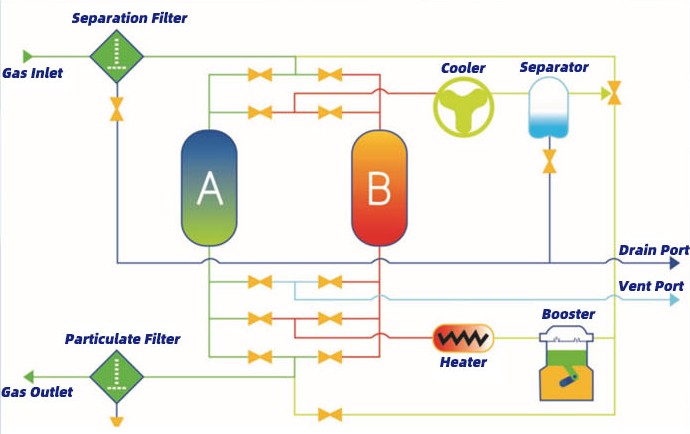
Yipu Coalbed Methane Dehydration Unit adopts the classic pressure swing adsorption principle, with an efficient and reliable process:
- Gas Inlet and Pretreatment: Low-pressure, saturated wet gas from coalbed methane wells first enters the unit and is filtered to remove possible entrained dust and liquid droplets, protecting subsequent core components.
- Dual-Tower/Multi-Tower Adsorption Dehydration (Core Process):
- Adsorption Process: The pretreated gas enters the bottom of an adsorption tower filled with 3A or 4A molecular sieves. Under pressure, water molecules in the gas are selectively adsorbed by the molecular sieves, and dry gas flows out from the top of the tower.
- Parallel Operation and Switching: Meanwhile, another adsorption tower is in the regeneration or cooling stage. Under PLC control, the two towers automatically switch working states according to a set time cycle (12-48 hours) or based on outlet dew point monitoring, realizing continuous supply of dry gas.
- Regeneration and Cooling:
- Regeneration: The tower that has reached adsorption saturation is regenerated. The system adopts a closed or open cycle, heating a portion of the dry gas from the outlet to 150-180℃ and then passing it into the adsorption tower in the reverse direction. High temperature desorbs the water adsorbed by the molecular sieves, restoring their drying capacity.
- Cooling: The adsorption tower after high-temperature regeneration needs to be cooled with cooled gas (via air cooling or water cooling) to restore it to a temperature suitable for adsorption, preparing for the next cycle. The regenerated gas is cooled to separate and discharge liquid water.
- Purified Gas Transmission: The dry gas after deep dehydration has an atmospheric pressure dew point of -55℃ to -70℃. It then passes through an outlet filter (precision ≤3μm) to remove possible entrained molecular sieve dust, and finally becomes qualified commercial gas for transmission to pipeline networks or downstream users.
III. Working Principle
The core working principle of this unit is pressure swing adsorption and selective adsorption of molecular sieves.
- Selective Adsorption: The pore size of 3A molecular sieves only allows molecules smaller than it (mainly water molecules) to enter their crystal lattice and be firmly adsorbed, while larger molecules such as methane pass through smoothly, achieving deep dehydration. 4A molecular sieves can be used in occasions where partial small-molecule hydrogen sulfide or heavy hydrocarbons need to be removed simultaneously.
- Pressure Swing Adsorption: The adsorption process is carried out under relatively high pressure, while the regeneration process is achieved by reducing pressure (depressurization regeneration) and increasing temperature (heating regeneration). Utilizing the characteristic of molecular sieves having different adsorption capacities under different pressures and temperatures, a cycle of “high-pressure adsorption – low-pressure high-temperature desorption” is formed, realizing continuous water removal.
IV. Core Advantages
- Super Strong Working Condition Adaptability: The extremely wide working pressure range (0.1-8.0MPa) enables it to perfectly adapt to various working conditions from low-pressure coalbed methane to high-pressure associated gas, which is the key to solving the low-pressure pain point of coalbed methane.
- Deep Dehydration with Excellent Effect: The outlet dew point is as low as -70℃, which can completely prevent hydrate formation, ensure pipeline safety, and significantly improve gas calorific value.
- Full-Automatic Intelligent Operation: The PLC-based full-automatic control system realizes one-key start-stop, automatic switching, and fault alarm, supports remote monitoring and maintenance, greatly reducing manual intervention and operation and maintenance costs, and is very suitable for unattended coalbed methane well sites.
- High Efficiency, Energy Saving and Environmental Protection:
- Closed-cycle regeneration technology can significantly reduce the product gas consumed as regenerated gas, improving yield.
- Power configuration matches the processing capacity, with controllable energy consumption.
- Molecular sieves are solid adsorbents, producing no liquid chemical waste, and the process is clean and environmentally friendly.
- High Reliability and Long-Cycle Operation: The single-tower continuous working time is up to 48 hours, the system design pressure (up to 9.0MPa) has sufficient safety margin, the inlet and outlet pressure drop is ≤50kPa, and energy consumption loss is small. The EXD Ⅱ BT4 explosion-proof rating and IP54/IP65 protection rating ensure safe and stable operation in harsh environments.
V. Technical Strength
- Modular and Serialized Design: Offers a wide flow range from 500 to 20,000 Nm³/h and up to 8 size specifications, demonstrating strong modular design capabilities and the ability to quickly respond to project needs of different scales.
- Flexible Process Integration Capabilities: Provides various optional configurations such as “air cooling/water cooling”, “closed/open regeneration”, and “depressurization/isobaric regeneration”, which can be optimally combined according to the customer’s on-site energy conditions (water resources, temperature) and process requirements.
- Application of Core Material Science: Has a deep understanding of the characteristics and application scenarios of 3A/4A molecular sieves, and can accurately select models according to the specific composition of coalbed methane (such as whether it contains sulfur) to ensure dehydration effect and equipment service life.
- Strict Quality Assurance: Can provide mechanical test reports and video factory inspection, reflecting the full-process quality control system from design, manufacturing to testing.
- Forward-Looking Intelligent Design: The built-in PLC system and remote interface provide underlying support for realizing digital oilfields and intelligent station management, in line with industry technology development trends.
VI. Product Introduction
- Product Category: Coalbed Methane Dehydration Unit
- Brand: Yipu
- Core Components: Adsorption tower, 3A/4A molecular sieve, regenerated gas heater, PLC electrical control system, compressor
- Working Mode: Dual-tower/multi-tower alternation, continuous cyclic operation
- Control Method: PLC programmable controller automatic control, supporting manual/automatic switching
- Place of Origin: Zhejiang, China
This unit is a high-efficiency purification equipment specially designed for the characteristics of coalbed methane. Through deep dehydration, it converts substandard coalbed methane into high-quality commercial natural gas.
VII. Application Scenarios
- Main Applications: On-site dehydration treatment of coalbed methane well sites and gathering stations.
- Widely Applicable: Also suitable for dehydration of shale gas, oilfield associated gas, and biogas, as well as deep dehydration of natural gas in urban pipeline network pressure regulating stations to ensure the safety of long-distance transmission pipelines.
- Extended Fields: Can be used for raw gas pretreatment of CNG mother stations and various industrial fields requiring low dew point process gas.
VIII. Key Technical Indicators
| Indicator Category | Parameter Details | Technical and Market Significance |
|---|---|---|
| Processing Capacity | 500 ~ 20,000 Nm³/h | Covers the full range of needs from single wells to small-scale gathering stations with strong adaptability |
| Working Pressure | 0.1 ~ 8.0 MPa | One of the core advantages, perfectly solving the low-pressure pain point of coalbed methane |
| Outlet Dew Point | ≤ -55℃ ~ -70℃ | Core performance indicator, deep dehydration, far exceeding pipeline transmission standards |
| Adsorbent | 3A / 4A Molecular Sieve | Technical core, realizing selective deep adsorption |
| Continuous Working Time | 12 ~ 48 h/tower | Long-cycle operation, reducing switching, improving stability and convenience |
| Regeneration Time | ≤ 8 h | Rapid regeneration, ensuring timely system backup and high reliability |
| Control and Automation | PLC, Full-Automatic, Fault Alarm | Core guarantee for realizing unattended operation and reducing operation and maintenance costs |
| Energy Consumption | Power: 12.3 ~ 150 kW | Wide-range power configuration, matching processing capacity, focusing on economy |
| Safety Certification | Explosion-Proof: EXD Ⅱ BT4; Protection: IP54/IP65 | Meets high-risk explosion-proof requirements in coal mining areas, oil and gas fields, etc. |
Coalbed Methane Dehydration Unit – Technical Specification Sheet
| Item | Specification | Item | Specification |
|---|---|---|---|
| Product Category | Coalbed Methane Dehydration Unit | Working Medium | Oilfield Associated Gas, Shale Gas, Natural Gas, Coalbed Methane, Biogas |
| Brand | Yipu | Place of Origin | Zhejiang, China |
| Working Flow Rate | 500~20,000 Nm³/h | Core Components | Motor, Compressor, Adsorption Tower, Molecular Sieve, Filter, Booster, Cooler, Separator, Heater, Control Valve & Control System |
| Core Advantages | Stable & Efficient Operation, Full-Automatic Control, Energy-Saving & Environmental Protection, Remote Maintenance | Application Scenarios | Coalbed Methane Extraction, Transportation & Liquefaction Industry; CNG Mother Station & Refueling Station; Urban Gas & Industrial Fuel; Power Generation Industry; Chemical & Fertilizer Industry |
| Mechanical Test Report | Available | Video Factory Inspection | Available |
| Working Pressure | 0.1~8.0 MPa | Inlet Temperature | 0~40℃ (50℃) |
| Inlet Pressure Dew Point | 0.6 MPa/-13℃/Water-Saturated | Single-Tower Continuous Working Time | 12~48 h |
| System Design Pressure | 1.0~9.0 MPa | Regeneration Time | ≤8 h (10 h) |
| Adsorbent | 3A/4A Molecular Sieve | Outlet Atmospheric Dew Point | ≤-55℃~-70℃ |
| Regeneration Cooling Method | Air Cooling/Water Cooling | Outlet Filtration Precision | ≤3 μm |
| Power Supply/Power | 380V/50Hz/12.30~150 kW | Protection Class | IP54 or IP65 |
| Inlet & Outlet Pressure Drop | ≤50 kPa | Motor Explosion-Proof Class | ExdⅡ BT4 |
| Noise Level | ≤85 dB | Regenerated Gas Heating Temperature | 150~180℃ |
| Overall Dimensions | L: (2500~8000) mmW: (1600~3000) mmH: (2350~2850) mm | Equipment Weight | 2000~7000 kg |
| Inlet & Outlet Pipe Diameter | DN50~DN200 | ||
| Working Mode | “Dual-Tower/Multi-Tower Alternating ‘Adsorption-Regeneration’Continuous Gas Supply” | Regeneration Method | “Closed/Open Cycle, Depressurization/IsobaricRegeneration/Heated Regeneration” |
| Control Method | “PLC Programmable Controller, Digital Temperature ControlInstrument, Automatic Fault Alarm” | Switching Mode | Manual/Automatic |
Packaging, Shipping & Quotation Information
| Item | Specification | Item | Specification |
|---|---|---|---|
| Sales Unit | Single Unit/Set | Individual Package Dimension | 250020002850 (LWH) mm |
| Individual Product Gross Weight | 3000 kg | Packaging Method | Wooden Case/Triple-Proof Cloth (Waterproof, Mildewproof, Corrosion-Proof) |
| Quotation | $28,000~$100,000 |