
PSA Pressure Swing Adsorption Oxygen Generator


Yipu Pressure Swing Adsorption (PSA) Oxygen Generator precisely addresses users’ core demands for low-cost, high-efficiency, stable, and reliable on-site oxygen supply with its outstanding energy-saving performance, low investment cost, and high automation. It successfully provides an advanced, economical, and practical solution between high-cost cryogenic separation and traditional bottled oxygen, making it the preferred equipment for…
Yipu Pressure Swing Adsorption (PSA) Oxygen Generator precisely addresses users’ core demands for low-cost, high-efficiency, stable, and reliable on-site oxygen supply with its outstanding energy-saving performance, low investment cost, and high automation. It successfully provides an advanced, economical, and practical solution between high-cost cryogenic separation and traditional bottled oxygen, making it the preferred equipment for technological transformation, energy conservation, consumption reduction, and competitiveness enhancement in numerous industrial fields.
I. Market Pain Points
- High Cost and Low Efficiency: Traditional cryogenic air separation oxygen generation equipment requires huge investment, has a long startup time, and high energy consumption, resulting in poor economy for small-to-medium-scale oxygen demand or intermittent operation scenarios. Long-term use of bottled oxygen incurs high costs and carries risks of unstable transportation and supply.
- Purity Requirements and Process Matching: Many industrial fields (e.g., oxygen-enriched combustion, wastewater treatment, chemical oxidation) do not require high-purity oxygen above 99%; oxygen purity of 90%-94% is fully sufficient and more economical. The market urgently needs a low-cost solution that provides “appropriate purity.”
- Complex Operation and Maintenance: Cryogenic equipment is complex to operate and requires professional teams for maintenance. Traditional oxygen generation equipment has low automation and slow fault response, affecting continuous production.
- Equipment Flexibility and Space Requirements: Many application sites have limited space, requiring modular, skid-mounted equipment that can be quickly installed and commissioned.
- Energy Consumption Pressure: As major energy consumers, the operating electricity costs of oxygen generation equipment are a significant expenditure for enterprises, making energy conservation and consumption reduction a core demand.
II. System Process
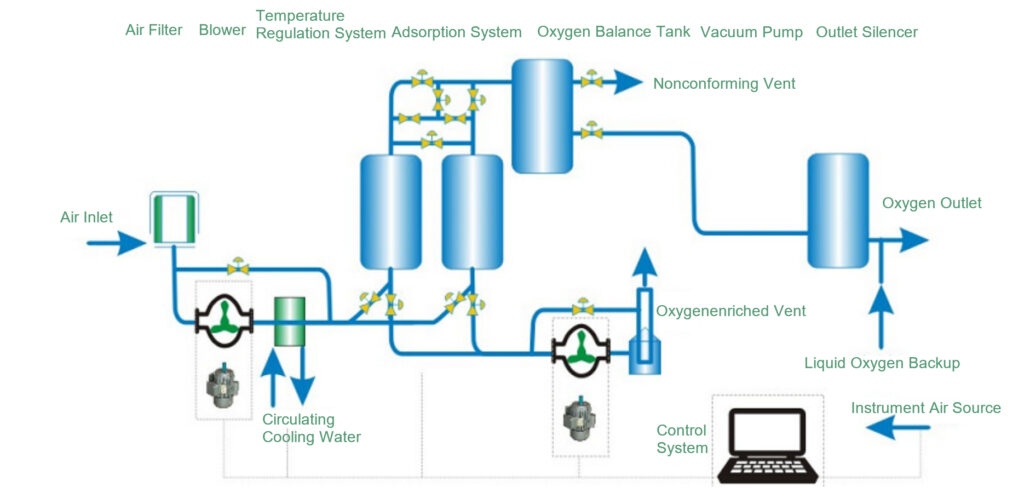
Yipu PSA Oxygen Generation System adopts a “blower adsorption” cycle process, which is efficient and energy-saving:
- Air Blowing and Pretreatment: Ambient air is filtered to remove dust, then pressurized to a low positive pressure (usually 20-60kPa) by a roots blower to provide power for adsorption. The temperature of the pressurized air rises and needs to be cooled by a cooler to improve adsorption efficiency.
- Adsorption Separation (Oxygen Production): The cooled air enters an adsorber (Tower A) filled with special zeolite molecular sieves (ZMS) from the bottom. ZMS has much stronger adsorption capacity for nitrogen, water vapor, and carbon dioxide than oxygen. Therefore, impurities such as nitrogen are adsorbed, while oxygen (purity 70%~94%) is enriched in the gas phase, output from the top of the tower as product gas, and stored in an oxygen buffer tank.
- Vacuum Regeneration: When the adsorption of nitrogen by the molecular sieves in Tower A is nearly saturated, the system switches automatically. A roots vacuum pump evacuates Tower B to negative pressure (e.g., -40kPa ~ -60kPa). Under negative pressure, the adsorbed nitrogen, moisture, and CO₂ are quickly desorbed and discharged into the atmosphere as waste gas through a muffler, thereby regenerating the molecular sieves.
- Pressure Equalization and Switching: A pressure equalization step is usually added between adsorption and regeneration. The oxygen-rich gas in the tower that is about to complete adsorption is introduced into the tower that has just finished regeneration to recover pressure and gas, significantly reducing system energy consumption.
- Continuous Output: Controlled by PLC-operated switching valves, two or more adsorbers alternately perform the cycle of adsorption → pressure equalization (depressurization) → vacuum regeneration → pressure equalization (pressurization), ensuring continuous and stable oxygen production. The product oxygen can be pressurized by a booster for use as needed.
III. Working Principle
The core working principle is based on “Pressure Swing Adsorption (PSA)” and “equilibrium adsorption effect.”
- Selective Adsorption: The core lies in zeolite molecular sieves (ZMS). This adsorbent has extremely high affinity and adsorption capacity for nitrogen molecules, mainly based on the electrostatic interaction between nitrogen (with a quadrupole moment) and the cations on the molecular sieve surface, which is much stronger than that of oxygen (without a dipole moment). Therefore, under pressurized conditions, a large amount of nitrogen is adsorbed, and oxygen is enriched.
IV. Core Advantages
- Extremely Low Energy Consumption, Economical Operation: Adopts “blower adsorption” with operating pressure much lower than cryogenic separation and high-pressure PSA. It is one of the most energy-saving on-site oxygen generation technologies currently available, significantly reducing long-term operating costs.
- Intelligence and High Reliability: PLC full-automatic control enables one-key start-stop, fault self-diagnosis and alarm, and remote monitoring. The system operates stably, supports unattended operation, and requires simple maintenance.
- Rapid Start-Stop, High Flexibility: The equipment can start and produce qualified oxygen within 30 minutes, adapting to the needs of intermittent production or peak-shaving oxygen use. It covers a wide product scale (5~6000Nm³/h) and can be configured on demand.
- Low Investment Cost, Quick Installation: Compared with cryogenic air separation, the initial investment is significantly reduced. The integrated skid-mounted design features a compact structure and short on-site installation cycle; only power supply and product gas pipelines need to be connected.
- Good Safety Performance: Operates at room temperature and low pressure, with no dangerous working conditions such as high temperature and high pressure, and is much safer than high-pressure equipment and cryogenic equipment.
V. Technical Strength
- Core Adsorbent Technology: Proficiency in the selection and loading process of high-performance zeolite molecular sieves, which is the key to ensuring oxygen purity, output, and energy consumption.
- Advanced Process Design: Adopts multi-tower process and pressure equalization technology, optimizes timing control, and maximizes oxygen recovery rate and system energy efficiency.
- Precise Matching of Power Equipment: Integrates optimized selection and matching of roots blowers and roots vacuum pumps to ensure the system operates at the highest efficiency point.
- Valve and Control System: Uses fast-response switching valves and stable control systems to ensure accurate and reliable cycle switching and extend equipment service life.
VI. Product Introduction
- Product Name: Yipu Pressure Swing Adsorption (PSA) Oxygen Generator
- Brand: Yipu
- Core Process: PSA (Pressure Swing Adsorption)
- Adsorbent: Special Zeolite Molecular Sieve (ZMS)
- Working Mode: Dual-tower/multi-tower alternation, continuous cyclic operation
- Control Method: PLC programmable controller, full-automatic operation
VII. Application Scenarios
- Metallurgical Industry: Electric furnace steelmaking, blast furnace/cupola oxygen-enriched blast, copper/lead/zinc smelting furnaces—improves combustion temperature and efficiency, increases output, and reduces consumption.
- Environmental Protection Engineering: Wastewater treatment (aeration in aerobic tanks), oxygen-enriched combustion in waste incinerators—enhances treatment efficiency and reduces pollutant emissions.
- Chemical Industry: Various oxidation reactions (e.g., propylene oxide production), coal gasification, feed gas for ozone generators.
- Glass and Building Materials: Oxygen-enriched combustion in glass melting furnaces—saves energy, reduces consumption, and improves glass quality.
- Medical and Health Care: Oxygen bars, oxygen therapy, sports health care (requires supporting precision treatment and post-pressurization systems).
- Aquaculture: Increases dissolved oxygen in water, improves breeding density and survival rate.
- Pulp Bleaching, Cutting, and Welding: Provides an economical and efficient oxygen source.
VIII. Technical Specifications
| Parameter Item | Technical Indicators / Description |
|---|---|
| Product Name | PSA Pressure Swing Adsorption Oxygen Generator |
| Oxygen Output | 5 ~ 6000 Nm³/h (Wide range coverage) |
| Oxygen Purity | >70% ~ 94% (Adjustable according to process requirements) |
| Oxygen Pressure | VPSA: ≤ 20 KPa (Can be equipped with post-installed booster)PSA: ≤ 0.8 MPa |
| Core Technology | PSA (Pressure Swing Adsorption) process |
| Core Components | Roots blower, roots vacuum pump, zeolite molecular sieve adsorber, PLC control system |
| Core Advantages | Energy-Saving & Environmental Protection, Full-Automatic Operation, Low Investment, Flexible Application |