
Hydrogen Nitrogen Purification Equipment


Yipu Hydrogenation Nitrogen Purification Equipment is an efficient purification solution based on room-temperature catalytic technology and intelligent control systems. Through automatic precise hydrogen injection and dual-catalyst combination technology, it achieves deep removal of trace oxygen in nitrogen while ensuring absolute safety, and can be flexibly configured to meet different requirements of hydrogen removal or retention….
Yipu Hydrogenation Nitrogen Purification Equipment is an efficient purification solution based on room-temperature catalytic technology and intelligent control systems. Through automatic precise hydrogen injection and dual-catalyst combination technology, it achieves deep removal of trace oxygen in nitrogen while ensuring absolute safety, and can be flexibly configured to meet different requirements of hydrogen removal or retention. Its high efficiency, stability, and automation make it an ideal choice for industrial fields with high standards for nitrogen purity and an open or acceptable attitude towards hydrogenation processes.
1. Market Pain Points
- Extreme Requirements for Deep Deoxygenation: In fields such as electronics, metallurgy, and chemicals, industrial nitrogen (purity 99.9%~99.999%) produced by front-end nitrogen generation equipment (e.g., PSA, VPSA) still contains 100-1000ppm of oxygen. These trace oxygen can cause product oxidation, process failure, or catalyst poisoning, and must be deeply removed to below ppm level.
- Limitations of Traditional Deoxygenation Methods: Carbon-supported catalytic deoxygenation requires heating, leading to energy consumption issues; while room-temperature catalytic deoxygenation technology has extremely high requirements for catalyst activity and system control precision.
- Safety Risks of Hydrogenation Process: Hydrogen is a flammable and explosive gas. How to accurately and safely control the hydrogen injection amount to prevent the hydrogen-oxygen ratio from entering the explosive limit is the biggest safety challenge faced by the hydrogenation deoxygenation process.
- New Problems Caused by Hydrogen Residue: For certain non-hydrogen-sensitive processes, although hydrogenation is allowed, excessive hydrogen residue may still affect product quality or downstream processes and needs to be effectively removed.
- Automation and Reliability of System Operation: Purification equipment needs to operate stably for a long time, automatically respond to fluctuations in inlet conditions (flow rate, oxygen content), and be equipped with complete safety interlock protection.
2. System Process
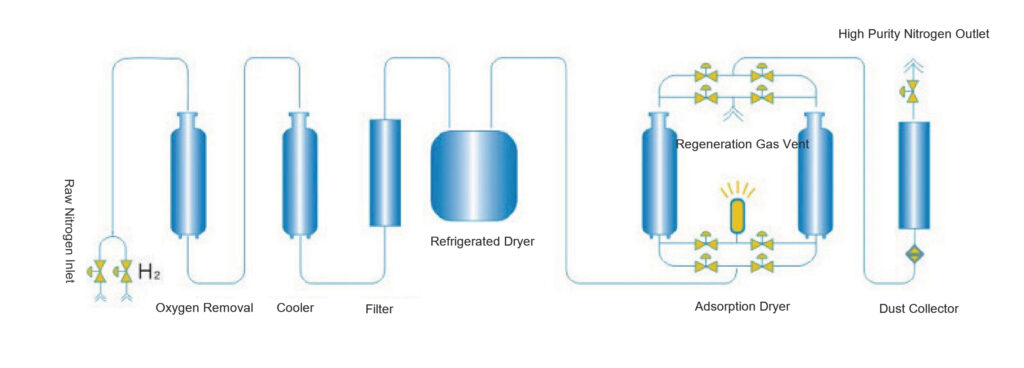
This equipment is used as a downstream purification unit, combined with a front-end nitrogen generation unit. Its core process revolves around the combination of two high-efficiency catalysts:
- Front-End Nitrogen Input: Receives industrial nitrogen (usually with oxygen content of 100-1000ppm) from the front-end nitrogen generation equipment.
- Precision Hydrogen Injection and Mixing: Through a high-precision metering and control system, the system automatically and accurately injects hydrogen according to the stoichiometric ratio (slightly higher than O₂:H₂=2:1) based on the flow rate and real-time oxygen content of the inlet nitrogen, ensuring thorough mixing.
- Room-Temperature Catalytic Deoxygenation (Core Step): The hydrogen-oxygen mixture enters the deoxygenation catalyst bed (filled with precious metal catalysts such as palladium/platinum). Under the action of the catalyst, hydrogen and oxygen undergo a combination reaction at room temperature: 2H₂ + O₂ → 2H₂O, generating water vapor. This step reduces the oxygen concentration to ≤5ppm.
- Cooling and Gas-Water Separation: The reaction is exothermic, so the temperature of the outgoing gas will rise slightly. The gas is then cooled by a cooler, condensing most of the generated water vapor into liquid water, which is discharged from the system through a high-efficiency gas-water separator.
- Deep Dehydration Drying: The nitrogen after separation still contains saturated water vapor, which enters an adsorption dryer (filled with high-performance molecular sieves) for deep dehydration, reducing the dew point to < -60℃.
- (Optional) Hydrogen Removal Unit: For working conditions requiring the removal of excess hydrogen, the gas will enter the hydrogen removal catalyst bed. Here, excess hydrogen reacts with pre-introduced or artificially injected trace oxygen (or oxygen in air) under the action of the catalyst to generate water, which is removed again by the subsequent drying unit, ultimately obtaining high-purity hydrogen-free nitrogen.
- Precision Filtration and Output: Finally, the nitrogen passes through a high-precision filter to remove any possible entrained particulates, producing the final high-purity nitrogen.
3. Working Principle
The core working principle is “catalytic chemical reaction + physical adsorption”.
- Catalytic Deoxygenation: Uses precious metal catalysts such as palladium and platinum to reduce the activation energy of the reaction, enabling hydrogen and oxygen to efficiently and rapidly generate water at room temperature. The reaction is complete with extremely high deoxygenation depth.
- Catalytic Hydrogen Removal (Optional): Similarly uses a catalyst to react residual hydrogen with quantitatively added oxygen to generate water, thereby removing hydrogen.
- Physical Adsorption: Utilizes the strong adsorption capacity of molecular sieves for water molecules to deeply remove water generated by the reaction, achieving an extremely low dew point.
4. Core Advantages
- Room-Temperature Deoxygenation, High Efficiency and Energy Saving: The catalyst has high activity, enabling deep deoxygenation without external heating. Compared with the carbon-supported catalytic method that requires heating, energy consumption is significantly reduced.
- Intelligent Hydrogen Control, Safe and Reliable: The core advantage lies in the automatic hydrogen injection control system, which is interlocked with online flow rate and oxygen content analyzers to ensure the hydrogen-oxygen ratio is always far from the explosive limit. It is equipped with an intelligent interlock vent valve that automatically exhausts gas in case of abnormalities, providing comprehensive safety guarantee.
- Dual-Catalyst Combination, Flexible and Pure: Adopts a combined process of two high-efficiency catalysts, which can not only achieve deep deoxygenation but also selectively remove hydrogen according to customer needs, flexibly producing high-purity nitrogen with or without hydrogen.
- High Automation Level, Stable Operation: PLC full-automatic control realizes one-key start-stop, automatic parameter adjustment, and multiple fault alarms, reducing dependence on operators and ensuring long-term stable product gas quality.
- Excellent Performance, Outstanding Indicators: Can stably produce high-quality nitrogen with purity > 99.9995%, oxygen content ≤5ppm, and dew point < -60℃.
5. Technical Strength
- Core Catalyst Technology: Masters the selection and application technology of high-performance, long-life room-temperature deoxygenation catalysts and hydrogen removal catalysts.
- Precision Control System Algorithm: Possesses accurate hydrogen injection control algorithms that can quickly respond to changes in front-end gas flow and concentration, which is the core of safe and efficient system operation.
- System Integration and Safety Design: Proficient in the design of safety instrumented systems, effectively integrating sensors, controllers, and actuators (such as emergency shut-off valves, vent valves) to build multiple safety barriers.
- Modularization and Customization Capabilities: Can provide customized solutions with or without hydrogen removal units according to customers’ specific requirements for hydrogen content in the final product gas.
6. Product Introduction
- Product Name: Yipu Room-Temperature Hydrogenation Nitrogen Purification Equipment
- Brand: Yipu
- Core Process: Room-Temperature Catalytic Hydrogenation Deoxygenation + (Optional) Catalytic Hydrogen Removal + Deep Dehydration
- Working Mode: Continuous Purification
- Control Method: PLC Full-Automatic Control, Equipped with High-Precision Analyzers, Flow Meters, and Safety Interlock Systems
7. Application Scenarios
- Electronics Industry (Non-Hydrogen-Sensitive Links): Protective gas for certain links in the manufacturing of liquid crystal panels and photovoltaic cells.
- Metallurgical Industry: Bright annealing of non-ferrous metals such as copper and nickel (some processes can accept trace hydrogen).
- Chemical and Petrochemical Industry: Used as protective gas and sealing gas for reactors to prevent material oxidation.
- Aerospace: Heat treatment processes of certain materials.
- When Equipped with Hydrogen Removal Unit: Can be applied to all hydrogen-sensitive scenarios, such as stainless steel bright annealing and semiconductor manufacturing, achieving the same high-purity hydrogen-free effect as carbon-supported purification equipment.
8. Technical Specifications
| Parameter Item | Technical Indicators / Description |
|---|---|
| Product Name | Hydrogenation Nitrogen Purification Equipment |
| Processing Capacity (Inlet Industrial Nitrogen) | 10 ~ 2000 Nm³/h |
| Outlet Nitrogen Purity | > 99.9995% |
| Outlet Oxygen Content | ≤ 5 ppm |
| Outlet Water Content (Dew Point) | < -60 ℃ |
| Deoxygenation Method | Room-Temperature Catalytic Hydrogenation Deoxygenation |
| Hydrogen Removal Function | Optional configuration to meet hydrogen-sensitive requirements |
| Core Advantages | Room-Temperature Energy Saving, Intelligent Hydrogen Control, Safe and Reliable, Flexible Hydrogen Removal |