
Carbon-Carrying Nitrogen Generator


Yipu Carbon-Supported Purification Nitrogen Generator is a professional solution tailored for the cutting-edge demand of ultra-high purity and hydrogen-free environments. Through innovative hydrogen-free catalytic deoxygenation technology combined with mature adsorption purification processes, it successfully solves the industry challenge that traditional methods cannot balance ultra-high purity and absolute safety. It is an indispensable key gas purification…
Yipu Carbon-Supported Purification Nitrogen Generator is a professional solution tailored for the cutting-edge demand of ultra-high purity and hydrogen-free environments. Through innovative hydrogen-free catalytic deoxygenation technology combined with mature adsorption purification processes, it successfully solves the industry challenge that traditional methods cannot balance ultra-high purity and absolute safety. It is an indispensable key gas purification equipment in high-end manufacturing and frontier technology fields. At a certain temperature, residual oxygen in nitrogen undergoes an oxidation reaction with carbon provided by the carbon-supported catalyst (C + O₂ → CO₂). The generated carbon dioxide (CO₂) is removed through pressure swing adsorption (PSA) process, followed by deep dehydration to obtain high-purity nitrogen.
1. Market Pain Points
- Stringent Requirements for Extreme Purity and Trace Oxygen: In fields such as semiconductors, high-end metal processing, and precision chemicals, nitrogen purity is not only required to be higher than 99.999% but also residual oxygen concentration must be controlled at extremely low ppm or even ppb levels. Traditional PSA/VPSA nitrogen generators (purity 99.9%~99.999%) and membrane separation methods cannot stably meet this standard.
- Risks Caused by Hydrogen Introduction: Some catalytic deoxygenation processes require hydrogen as a reducing agent, forming “hydrogenation deoxygenation”. This is absolutely prohibited for hydrogen-sensitive processes (e.g., certain stainless steel heat treatment, electronic component manufacturing), as it poses risks of hydrogen embrittlement, product degradation, and even safety accidents.
- Demand for Deep Drying: Trace moisture is also a natural enemy of many high-end processes, which can cause catalyst poisoning, product oxidation, or process failure. The outlet dew point of ordinary dryers (-40℃) cannot meet the requirements.
- Comprehensive Control of Impurity Content: In addition to oxygen and moisture, physical impurities such as particulates also need to be strictly filtered to ensure the normal operation of downstream precision equipment.
- Operational Stability and Reliability: The purification system must be able to maintain product gas indicators within the promised range stably for a long time; any fluctuation may cause huge quality losses.
2. System Process
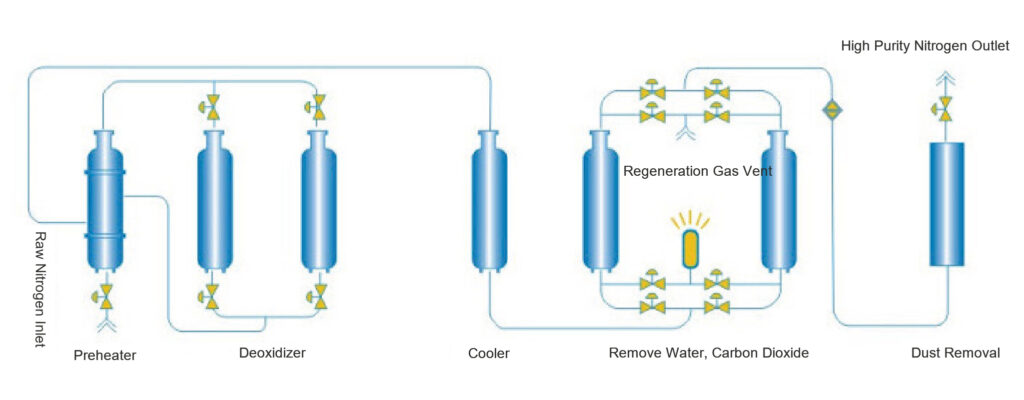
This system is usually used as a downstream purification unit, combined with a front-end nitrogen generation unit (e.g., PSA, VPSA) to form a complete ultra-high purity nitrogen supply system. Its core purification process is as follows:
- Front-End Nitrogen Input: Receives industrial nitrogen (usually with a purity of around 99.9% and oxygen content ~0.1%) from the front-end nitrogen generation equipment.
- Preheating and Catalytic Deoxygenation: Industrial nitrogen is first preheated by a heater to the optimal activation temperature of the carbon-supported catalyst (usually 200-400℃). Subsequently, the gas enters a catalytic oxidation tower filled with carbon-supported catalyst. Here, residual oxygen (O₂) in nitrogen undergoes an oxidation reaction with carbon (C) provided by the catalyst: C + O₂ → CO₂. This step converts O₂, which is difficult to adsorb directly, into CO₂, which is easy to remove.
- Cooling: The high-temperature nitrogen (rich in CO₂) from the catalytic oxidation tower is cooled to near room temperature through a heat exchanger or cooler, preparing for the subsequent adsorption step.
- Pressure Swing Adsorption (PSA) Decarbonization: The cooled gas enters a carbon dioxide adsorption tower (equipped with high-efficiency adsorbents such as 13X molecular sieves), and the CO₂ generated in the previous step is deeply adsorbed and removed based on the principle of pressure swing adsorption.
- Deep Dehydration: The nitrogen after CO₂ removal enters a deep drying module (usually also an adsorption dryer equipped with high-performance molecular sieves) to deeply remove moisture in the gas to a dew point ≤ -60℃.
- Precision Filtration: Finally, the nitrogen passes through a high-precision filter (e.g., 0.01μm) to remove extremely fine particulates that may be carried over from previous processes, ensuring the cleanliness of the product gas.
- Ultra-High Purity Nitrogen Output: After the above layers of purification, ultra-high purity nitrogen with oxygen content < 5ppm, dew point ≤ -60℃, and no dust is finally obtained.
3. Working Principle
The core working principle is a combined purification technology of “chemical conversion + physical adsorption”.
- Chemical Conversion (Deoxygenation): Using a carbon-supported catalyst, under heating conditions, residual oxygen is promoted to undergo an irreversible oxidation reaction with carbon in the catalyst framework to generate CO₂. This is a non-catalytic deoxygenation method that fundamentally avoids the introduction of hydrogen, with complete reaction and extremely high deoxygenation efficiency.
- Physical Adsorption (Decarbonization and Dehydration):
- Decarbonization: Utilizes the strong adsorption capacity of adsorbents such as 13X molecular sieves for CO₂ molecules to adsorb them under pressure and regenerate during depressurization.
- Dehydration: Uses the strong affinity of high-performance molecular sieves for water molecules to perform deep adsorption drying, achieving an extremely low dew point.
4. Core Advantages
- Hydrogen-Free Purification, Absolute Safety: Unique carbon-supported catalytic technology eliminates the need for any hydrogen addition, completely eliminating the risks of explosion, hydrogen embrittlement, and product contamination caused by hydrogen introduction, making it perfectly suitable for hydrogen-sensitive processes.
- Ultra-High Purity, Excellent Indicators: Can stably produce ultra-high purity nitrogen with purity > 99.9995%, residual oxygen < 5ppm, and dew point ≤ -60℃, meeting the most stringent industrial standards.
- Deep Deoxygenation and Dehydration: Reduces oxygen concentration to an extremely low level through chemical means, and combines with deep adsorption drying to solve the two key impurity problems of oxygen and moisture simultaneously.
- Stable and Reliable Operation: The system features a robust design, long catalyst service life, and stable purification process, ensuring consistent product gas quality without fluctuations over the long term.
- Integrated Design: Highly integrates heating, catalysis, cooling, adsorption, filtration, and other units, with a compact structure and simple operation, which can be flexibly matched with various front-end nitrogen generators.
5. Technical Strength
- Core Material Technology: Masters the formula and application technology of high-performance, long-life carbon-supported catalysts, which is the key to achieving efficient and stable hydrogen-free deoxygenation.
- System Integration and Process Optimization: Proficient in the matching and optimization of process parameters such as heating temperature, gas flow rate, and adsorption cycle, ensuring high efficiency and energy saving of the entire purification chain.
- Precise Temperature Control: Equipped with an accurate temperature control system to ensure that the catalytic reaction is always carried out within the optimal temperature window, both guaranteeing reaction efficiency and extending catalyst service life.
- Modular Design: Can provide customized purification module solutions according to customers’ different requirements for purity, flow rate, and inlet conditions.
6. Product Introduction
- Product Name: Yipu Carbon-Supported Purification Nitrogen Generation System (Ultra-High Purity Hydrogen-Free Type)
- Brand: Yipu
- Core Process: Carbon-Supported Catalytic Deoxygenation + PSA Decarbonization + Adsorption Deep Dehydration
- Working Mode: Continuous Purification (Catalytic Unit Operates Continuously, Adsorption Units Alternate Regeneration)
- Inlet Requirements: Industrial Nitrogen (from PSA/VPSA and other nitrogen generators)
- Control Method: PLC Full-Automatic Control, Real-Time Monitoring of Key Parameters such as Temperature, Purity, and Dew Point
7. Application Scenarios
- Semiconductor and Electronics Industry: Protective gas and carrier gas in wafer manufacturing, LED epitaxial growth, and semiconductor packaging processes.
- High-End Metal Heat Treatment: Hydrogen-sensitive processes such as stainless steel bright annealing, silicon steel sheet processing, and titanium alloy processing.
- Precision Chemical and Pharmaceutical Industry: Advanced synthetic reaction protection, catalyst protection, and pharmaceutical packaging.
- Aerospace: Atmospheric protection in rare metal welding and composite material manufacturing processes.
- Research Institutes: Various laboratories and analytical instruments with extreme requirements for gas purity.
8. Technical Specifications
| Parameter Item | Technical Indicators / Description |
|---|---|
| Product Name | Carbon-Supported Purification Nitrogen Generation System |
| Processing Capacity (Inlet Industrial Nitrogen) | 10 ~ 2000 Nm³/h |
| Outlet Nitrogen Purity | > 99.9995% |
| Outlet Oxygen Content | < 5 ppm |
| Outlet Water Content (Dew Point) | ≤ -60 ℃ |
| Outlet Dust Content | < 0.01 μm |
| Deoxygenation Method | Carbon-Supported Catalysis, Hydrogen-Free Purification |
| Core Advantages | Hydrogen-Free Safety, Ultra-High Purity, Deep Drying, Stable Operation |