
VPSA Pressure Swing Adsorption Nitrogen Generator


VPSA nitrogen generation is a mainstream and high-efficiency on-site nitrogen production process. Through the combination of “low-pressure adsorption + vacuum regeneration”, it significantly reduces system energy consumption while ensuring nitrogen purity, making it particularly suitable for industrial fields with large nitrogen demand. When your project requires continuous, stable, and low-cost large-volume nitrogen supply, VPSA is…
VPSA nitrogen generation is a mainstream and high-efficiency on-site nitrogen production process. Through the combination of “low-pressure adsorption + vacuum regeneration”, it significantly reduces system energy consumption while ensuring nitrogen purity, making it particularly suitable for industrial fields with large nitrogen demand. When your project requires continuous, stable, and low-cost large-volume nitrogen supply, VPSA is undoubtedly a highly competitive choice.
I. Market Pain Points
- High Energy Consumption and Operating Costs: Traditional cryogenic air separation nitrogen generation equipment involves large investment, slow startup, and extremely high energy consumption, which is uneconomical especially for small and medium-scale gas demand. Although bottled nitrogen or liquid nitrogen offers flexibility, it incurs high long-term usage costs, along with supply instability and transportation risks.
- Fluctuations in Nitrogen Purity and Flow Rate: Some production processes have strict requirements for nitrogen purity stability (e.g., 95%~99.999%). Traditional PSA nitrogen generation tends to have unstable purity when flow rate fluctuates, affecting product quality.
- High Equipment Reliability Requirements: In continuous production industries such as chemical and metallurgy, unexpected shutdown of nitrogen generation equipment may lead to the suspension of the entire production line, resulting in huge economic losses.
- Complex Operation & Maintenance and Insufficient Intelligence: Non-automated equipment requires dedicated personnel on duty, parameter adjustment relies on experience, and fault response is slow, failing to meet the digitalization and unattended operation needs of modern factories.
- Floor Space and Installation Cycle: Large-scale cryogenic equipment or complex non-skid-mounted nitrogen generation systems require significant workshop space and a long installation and commissioning cycle.
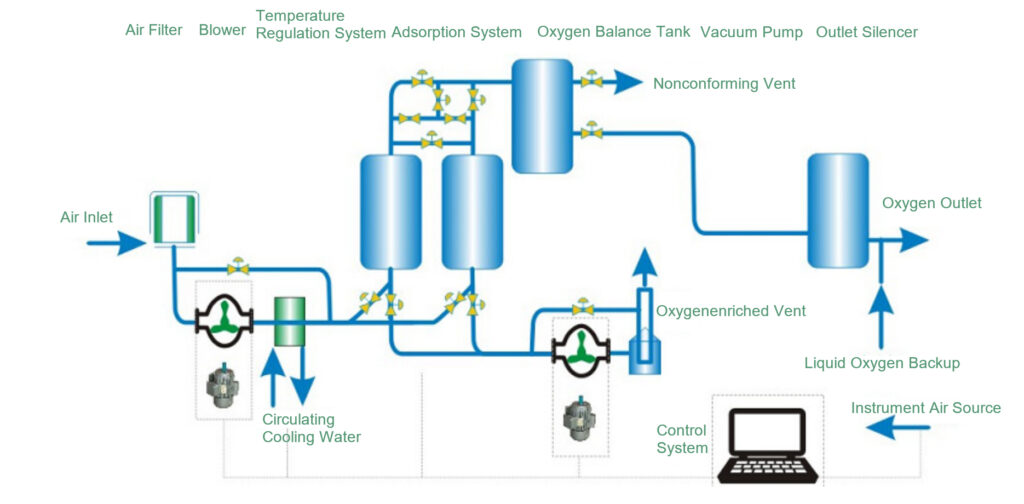
II. Basic Principle of VPSA Nitrogen Generation
The core principle of VPSA is to separate nitrogen and oxygen by utilizing the difference in adsorption rates of carbon molecular sieves (CMS) for oxygen and nitrogen in air.
- Adsorption Selectivity: The diffusion and adsorption rate of CMS for oxygen is much faster than that for nitrogen. Therefore, when compressed air passes through an adsorption tower filled with CMS, oxygen is preferentially adsorbed, and nitrogen flows out from the top of the tower as product gas.
- “Pressure Swing” and “Vacuum”: This is the key difference between VPSA and PSA.
- PSA: Adsorption occurs at relatively high pressure (usually 4-8 barg), followed by atmospheric pressure relief to release adsorbed oxygen and regenerate the molecular sieve.
- VPSA: Adsorption takes place at relatively low pressure (usually 0.3-0.8 barg), and regeneration is achieved by evacuating the tower to negative pressure (e.g., -0.65 barg). The vacuum environment greatly reduces the partial pressure of oxygen, enabling it to desorb from the molecular sieve more thoroughly and quickly.
III. System Process
The VPSA (Vacuum Pressure Swing Adsorption) process mainly includes compression, adsorption, pressure equalization, vacuum regeneration, and other steps, forming a continuous cycle:
- Air Compression and Pretreatment: Ambient air is drawn in by a roots blower (with lower energy consumption than air compressors) and pressurized to 0.3~0.8 BarG. It then enters a combined drying and filtration system to deeply remove moisture, oil, and particulate impurities, providing clean feed air for the adsorption towers.
- Adsorption Separation (Nitrogen Production): The pretreated compressed air enters one adsorption tower (Tower A) filled with carbon molecular sieves (CMS) from the bottom. CMS preferentially adsorbs oxygen, carbon dioxide, and water molecules, while nitrogen molecules (with larger kinetic diameter) are enriched and output from the top of the tower to obtain product nitrogen of the required purity.
- Pressure Equalization (Depressurization): Before Tower A reaches adsorption saturation, the system automatically shuts off the air intake. The high-pressure nitrogen in Tower A is released into Tower B, which has just completed regeneration, raising the pressure of Tower B to medium pressure. This process recovers energy and nitrogen, significantly improving yield and reducing energy consumption.
- Vacuum Regeneration: Tower A is evacuated (via a roots vacuum pump) to negative pressure (e.g., -0.65 BarG). At low pressure, impurities such as oxygen adsorbed by CMS are quickly desorbed and exhausted as waste gas, enabling thorough regeneration of the CMS in Tower A.
- Pressure Equalization (Pressurization) and Switching: Tower A, after regeneration, further increases its pressure by receiving equalization gas from Tower B, which is in the final stage of adsorption. The system then switches valves: Tower A enters the adsorption and nitrogen production stage, while Tower B starts pressure equalization (depressurization) and vacuum regeneration. The two towers alternate in this cycle to achieve continuous nitrogen production.
IV. VPSA Nitrogen Generation Process Flow (Typically Two or More Towers)
The core working principle is the combination of “Pressure Swing Adsorption (PSA)” and “kinetic effect”.
- Kinetic Separation: The interior of CMS is filled with micropores. The diffusion rate of oxygen molecules (diameter 3.46Å) is much faster than that of nitrogen molecules (diameter 3.64Å). During the pressurized adsorption stage, impurities such as oxygen and moisture diffuse into the micropores of CMS preferentially and quickly to be adsorbed. In contrast, most nitrogen molecules pass through the gas flow due to slow diffusion, resulting in enriched nitrogen at the outlet.
- Pressure Swing Adsorption: Adsorption is carried out under slight positive pressure to increase adsorption capacity. Regeneration significantly reduces the pressure of the adsorption tower through vacuum (the “V” in VPSA), forcing adsorbed impurities (mainly oxygen) to desorb. This cycle of “pressurized adsorption and vacuum desorption” is more efficient and energy-saving than the simple “pressurized adsorption and atmospheric desorption” (PSA).
A typical two-tower VPSA system workflow is as follows (the two towers alternate between adsorption and desorption for continuous nitrogen production):
Step 1: Tower A – Adsorption and Nitrogen Production
- Blowing and Adsorption: Ambient air is sent to Tower A via a blower (more energy-saving than air compressors due to low required pressure). Inside the tower, oxygen is adsorbed by CMS, and high-purity nitrogen flows out from the top, stabilized by a buffer tank before being supplied to users.
- Pressure Equalization: At the end of the adsorption process, Tower A has high internal pressure. Part of its gas is introduced into Tower B (which has completed regeneration) to balance the pressure between the two towers, saving energy.
Step 2: Tower A – Vacuum Desorption (Regeneration)
- Pressure Relief: Air intake to Tower A is stopped, and pressure is relieved for a short time.
- Vacuum Evacuation: The vacuum pump starts to evacuate Tower A, allowing adsorbed oxygen to desorb quickly and thoroughly from the molecular sieve and be discharged into the atmosphere through a muffler. The molecular sieve is thus regenerated, preparing for the next adsorption cycle.
Meanwhile, Tower B undergoes the opposite cycle: Tower B – Adsorption and Nitrogen Production → Tower B – Vacuum Desorption. This cycle repeats to achieve continuous production.
V. Key Features and Advantages of VPSA Nitrogen Generation
- Low Energy Consumption: This is VPSA’s biggest advantage. Due to adsorption under near-atmospheric pressure and the use of high-efficiency blowers and vacuum pumps, its comprehensive power consumption is usually 20% – 40% lower than that of PSA nitrogen generators with the same gas output.
- Economical Operation: Adopting the “blower + vacuum” combination and low working pressure (<1Bar), it saves 30%~50% more energy than traditional PSA and cryogenic methods, making it one of the most energy-saving on-site nitrogen production solutions currently available.
- Large Gas Output: The VPSA process is particularly suitable for medium and large-scale nitrogen demand, with conventional equipment output ranging from tens of Nm³/h to thousands of Nm³/h.
- Investment Cost: For small-scale equipment, VPSA’s advantages are not obvious. However, for large-scale equipment, although the cost of a single vacuum pump and blower is higher, its low energy consumption results in lower total cost during long-term operation.
- High Automation Level: The system is automatically controlled by PLC, with real-time monitoring of purity, pressure, and flow rate, and automatic timing adjustment to ensure stable purity. It features fault self-diagnosis and alarm functions, supports remote monitoring, and enables unattended operation.
- Rapid Start/Stop and Flexible Gas Usage: The equipment can start and produce qualified nitrogen within 30 minutes, and can be shut down immediately in case of emergencies. It is particularly suitable for production modes with intermittent gas demand or peak-valley power consumption.
- Skid-Mounted Modular Design and Easy Installation: All components are highly integrated into one or more skids, featuring a compact structure and convenient transportation. On-site installation only requires connecting power, water (if applicable), and gas production pipelines, greatly shortening the installation cycle.
- Low Maintenance and Long Service Life: The core adsorbent (CMS) has minimal performance degradation and a long service life (usually 8-10 years or more). The high-efficiency pre-filter system effectively protects the CMS, reducing maintenance frequency and costs.
VI. Comparison Between VPSA and PSA Nitrogen Generation
| Characteristics | VPSA (Vacuum Pressure Swing Adsorption) | PSA (Pressure Swing Adsorption) |
|---|---|---|
| Operating Pressure | Low pressure (0.3-0.8 barg) | Medium-high pressure (4-8 barg) |
| Regeneration Method | Vacuum desorption | Atmospheric desorption |
| Core Equipment | Blower + Vacuum pump | Air compressor + Atmospheric relief valve |
| Energy Consumption | Low, suitable for large-scale production | Relatively high |
| Nitrogen Output | Large (usually > 100 Nm³/h) | Small to medium (several to hundreds of Nm³/h) |
| Nitrogen Purity | Usually up to 95% – 99.999% | Also up to 95% – 99.999% |
| Applicable Scenarios | Chemical industry, metallurgy, float glass, large-scale food preservation, etc. | Electronics, small chemical industry, laser cutting, small to medium injection molding, etc. |
VII. Technical Strength
- Advanced Process Design: Adopts multi-stage pressure equalization technology to maximize energy and product gas recovery, significantly improving nitrogen recovery rate and system efficiency.
- High-Quality Core Components: Key power equipment (e.g., roots blowers, roots vacuum pumps) and control systems (PLC, valves) are sourced from well-known domestic and foreign brands to ensure the reliability of long-term operation of the entire machine.
- Precise CMS Loading and Compaction Technology: Prevents CMS from pulverization under gas flow impact, ensures uniform gas distribution, and is the key to achieving high purity, high yield, and long service life.
- Customization and Integration Capabilities: Provides the most economical and efficient customized solutions according to customer requirements for nitrogen purity (95%~99.999%), flow rate, and pressure. Can integrate post-nitrogen booster compressors and purity analyzers.
VIII. Application Scenarios
Due to its economy and large-scale production capacity, VPSA nitrogen generation is widely used in:
- Chemical and Petrochemical Industry: Pipeline purging, vessel replacement, product protection, nitrogen sealing, material nitrogen sealing, catalyst protection, product transportation.
- Metallurgy Industry: Bright annealing, brazing, sintering, carburizing treatment.
- Float Glass Production: Tin bath protective gas to prevent tin liquid oxidation.
- Food and Pharmaceutical Industry: Large-scale grain storage, modified atmosphere preservation of fruits and vegetables, nitrogen-filled packaging, pharmaceutical packaging, food nitrogen-filled preservation, atmospheric protection (anti-oxidation, anti-mildew).
- Electronic Manufacturing Industry: Protective gas and carrier gas in the production of semiconductor components, LEDs, and lithium batteries.
- Coal Mining: Coal mine fire prevention and extinguishing, gas dilution.
- Rubber and Tire Industry: Tire vulcanization, transportation and protection of plastic pellets.
IX. Technical Specifications
| Parameter Item | Technical Indicators / Description |
|---|---|
| Product Name | VPSA Vacuum Pressure Swing Adsorption Nitrogen Generator |
| Nitrogen Output | 10 ~ 3000 Nm³/h (Higher output customizable) |
| Nitrogen Purity | 95% ~ 99.999% (Adjustable according to requirements) |
| Outlet Pressure | 0.5 ~ 0.8 BarG (Pressure can be increased with post-installed booster) |
| Dew Point | ≤ -40℃ ~ -60℃ |
| Power Range | Dependent on output and purity, significantly lower than equivalent PSA equipment |
| Control Method | PLC full automatic control with touchscreen HMI |
| Core Components | Roots blower, roots vacuum pump, carbon molecular sieve (CMS), program-controlled valves |
| Noise Level | ≤ 80 ~ 85 dB (With noise reduction measures) |
| Core Advantages | Energy-saving and environmental protection, full automatic operation, stable and efficient, remote maintenance |