
Shale Gas Dehydration and Hydrocarbon Removal Equipment


Comprehensive Introduction to Yipu Shale Gas Dehydration and Hydrocarbon Removal Equipment Overview Yipu Shale Gas Dehydration and Hydrocarbon Removal Equipment is a technologically mature, high-performance, and highly intelligent high-end domestic equipment. It precisely addresses the core pain points in shale gas field development. With its deep purification capability, fully automatic operation, and strong adaptability, it…
Comprehensive Introduction to Yipu Shale Gas Dehydration and Hydrocarbon Removal Equipment
Overview
Yipu Shale Gas Dehydration and Hydrocarbon Removal Equipment is a technologically mature, high-performance, and highly intelligent high-end domestic equipment. It precisely addresses the core pain points in shale gas field development. With its deep purification capability, fully automatic operation, and strong adaptability, it holds significant advantages in market competition and serves as a key guarantee for the safe, efficient, and economical transportation of shale gas.
I. Market Pain Points
During shale gas extraction, the raw gas produced from wellheads contains saturated water vapor and heavy hydrocarbon components. Direct transportation poses a series of severe challenges, which are the core pain points that Yipu equipment aims to solve:
- Pipeline Ice Blockage and Corrosion: Moisture in the gas forms natural gas hydrates (ice blockages) under the low-temperature and high-pressure environment of transmission pipelines, clogging valves, pipelines, and equipment, leading to production shutdowns. Meanwhile, water combines with acidic gases (such as CO₂ and H₂S) to form acid solutions, which severely corrode pipelines, posing safety hazards and significantly increasing maintenance costs.
- Excessive Hydrocarbon Dew Point: Heavy hydrocarbon components condense into liquids as the temperature drops in pipelines, reducing transportation efficiency, causing the “water hammer” effect, damaging compression equipment, and failing to meet the strict requirements for hydrocarbon dew point in national pipeline transportation standards.
- Low Energy Efficiency: Liquid water and heavy hydrocarbons increase pipeline pressure drop, resulting in higher compressor load and significantly increased energy consumption.
- Difficult Operation and Maintenance in Remote Stations: Shale gas fields are usually located in remote areas. Gas gathering stations and well sites lack full-time personnel on duty, imposing extremely high requirements on the automation, reliability, and remote operation and maintenance capabilities of equipment.
- Environmental and Safety Pressures: Direct discharge or flaring of oil and hydrocarbon-containing wastewater causes environmental pollution; equipment requiring frequent manual operations also increases the risk of personnel exposure and operational errors.
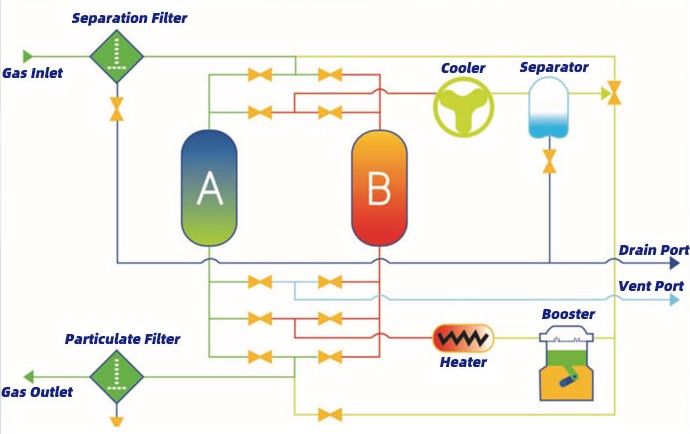
II. Equipment Process
The technological process of Yipu equipment follows the logic of “pretreatment → deep processing → purified gas transportation”, specifically as follows:
- Gas Inlet Pretreatment Unit: Raw gas from gathering pipelines (0.1-8.0Mpa, 0-40℃) first enters the equipment and passes through an inlet filter to remove solid particles and liquid droplets, protecting subsequent adsorbents.
- Dual-Tower/Multi-Tower Adsorption Dehydration and Hydrocarbon Removal Unit: This is the core of the equipment.
- Adsorption Process: The pretreated wet gas enters one of the adsorption towers filled with 3A/4A molecular sieves. The molecular sieves have precise pore sizes and can selectively adsorb water molecules (3A) or simultaneously adsorb water and small-molecule heavy hydrocarbons (4A), achieving deep dehydration and partial hydrocarbon removal. The other tower is in the regeneration or cooling stage.
- Automatic Switching: Before the working tower reaches adsorption saturation (single-tower continuous operation for 12-48 hours), the system automatically switches to the standby tower via PLC, realizing continuous and uninterrupted gas supply.
- Regeneration and Cooling Unit:
- Heating Regeneration: Closed/open cycle and pressure reduction/isobaric regeneration are performed on the saturated adsorption tower. The system heats a portion of the dry purified gas from the outlet to 150-180℃ and then passes it back into the adsorption tower in reverse to desorb the adsorbed moisture and hydrocarbons.
- Cooling: After regeneration, the tower body temperature is very high, requiring cooling with cooled gas (via air/water cooling) to prepare for the next switching.
- Purified Gas Transportation Unit: After deep processing by the adsorption tower, the gas has a water dew point as low as -55℃ ~ -70℃. It then passes through an outlet filter (precision ≤ 3μm) to ensure no adsorbent dust is carried out, and the final qualified dry gas is transported to downstream pipeline networks or users.
III. Working Principle
The core working principle of the equipment is the combination of Pressure Swing Adsorption (PSA) and selective adsorption.
- Selective Adsorption: 3A or 4A molecular sieves are used as adsorbents. 3A molecular sieves have a pore size of approximately 3 angstroms (Å), allowing only smaller water molecules to enter and be adsorbed while excluding most hydrocarbon molecules, thereby achieving deep dehydration. 4A molecular sieves have a slightly larger pore size (approximately 4Å), which can adsorb small-molecule heavy hydrocarbons such as ethane while adsorbing water, realizing integrated dehydration and hydrocarbon removal.
- Pressure Swing Adsorption: The equipment performs adsorption under relatively high pressure (0.1-8.0Mpa) and regeneration under low pressure (pressure reduction regeneration) or normal pressure. Utilizing the characteristic that the adsorption capacity of adsorbents varies with pressure, the adsorption and regeneration cycles are completed through periodic pressure changes, enabling continuous production.
IV. Core Advantages
- Deep Purification with Stable Compliance: The outlet dew point is as low as -70℃, far exceeding pipeline transportation standards. It can completely solve the problem of hydrate ice blockage and effectively control the hydrocarbon dew point.
- Fully Automatic Intelligent Operation: Equipped with a PLC programmable controller, it realizes full-process automation of “adsorption-regeneration-cooling-switching” with automatic fault alarm, making it particularly suitable for unattended remote stations.
- High Efficiency and Energy Saving:
- Flexible regeneration methods (closed-loop cycle) can significantly reduce product gas loss.
- Wide adaptability to working flow (500~20,000Nm³/h) and pressure (0.1~8.0Mpa), avoiding “overcapacity operation” of equipment.
- The regeneration gas heating temperature (150-180℃) is within a reasonable industry range, with controllable energy consumption.
- Robust and Reliable with Long-Cycle Operation: The single-tower continuous working time is up to 48 hours, with short regeneration time (≤8h), low switching frequency, and long equipment service life. The system design pressure is up to 9.0Mpa, leaving sufficient safety margin.
- Safety and Environmental Protection: EXD Ⅱ BT4 explosion-proof motor and IP54/IP65 high protection grade ensure safe operation in flammable, explosive, and harsh environments. Molecular sieves are solid adsorbents that do not produce liquid chemical waste, making them environmentally friendly and pollution-free.
V. Technical Strength
- Modular Design and Manufacturing Capability: Offers serialized products with pipe diameters from DN50 to DN200 and weights from 2 to 7 tons, demonstrating strong modular design and precision manufacturing capabilities to quickly respond to different customer needs.
- Advanced Process Package Integration: Masters various process combinations such as “dual-tower/multi-tower”, “closed/open regeneration”, and “air/water cooling”, and can provide optimal technical solutions according to customers’ gas source conditions and on-site situations.
- Optimized Selection of Core Materials: Has an in-depth understanding of the performance and application of adsorbents such as molecular sieves, enabling precise selection based on different priorities of dehydration or hydrocarbon removal.
- Strict Quality Control System: Can provide mechanical test reports and video factory inspections, reflecting confidence in product quality and a transparent quality management process.
- Intelligence and Remote Operation and Maintenance: Integrates PLC, digital display instruments, and remote communication interfaces, laying a hardware foundation for future “digital twin” and “remote maintenance”.
VI. Product Introduction
- Product Category: Shale Gas Dehydration and Hydrocarbon Removal Equipment
- Brand: Yipu
- Core Components: Adsorption tower, molecular sieve, compressor, heater, PLC control system
- Working Method: Dual-tower/multi-tower alternation for continuous gas supply
- Control Method: Fully automatic control via PLC programmable controller, supporting manual switching
- Place of Origin: Zhejiang, China
This series of equipment is a high-efficiency and intelligent device specially designed for the purification of shale gas and other natural gases. Through deep dehydration and hydrocarbon removal, it ensures that the quality of natural gas meets the requirements of pipeline transportation and utilization.
VII. Application Scenarios
- Main Applications: On-site treatment at well sites and gas gathering stations of shale gas fields.
- Extended Applications: Also suitable for the dehydration and hydrocarbon removal purification of oilfield associated gas, coalbed methane, biogas, and conventional natural gas. It also has broad application prospects in fields such as CNG/LNG mother stations and natural gas chemical industry.
VIII. Key Technical Indicators Overview
| Indicator Category | Parameter Details | Technical and Market Significance |
|---|---|---|
| Processing Capacity | 500 ~ 20,000 Nm³/h | Covers the needs from small wellheads to medium-sized gas gathering stations, with a wide application range |
| Working Pressure | 0.1 ~ 8.0 MPa | Adapts to wellhead pressure fluctuations and can be directly connected to various pressure conditions |
| Outlet Dew Point | ≤ -55℃ ~ -70℃ | Core performance indicator, achieving deep dehydration level and eliminating ice blockage |
| Adsorbent | 3A / 4A molecular sieve | Core technology, realizing selective adsorption to specifically solve dehydration or hydrocarbon removal problems |
| Continuous Working Duration | 12 ~ 48 h/tower | Long-cycle operation, reducing switching frequency and improving stability |
| Regeneration Time | ≤ 8 h | Rapid regeneration, quick standby, and high system reliability |
| Control and Automation | PLC, fully automatic, fault alarm | Enables unattended operation, reduces operation and maintenance costs, and serves as the foundation for intelligent operation and maintenance |
| Energy Consumption | Power: 12.3 ~ 150 kW | Energy consumption matches processing capacity, with an economically reasonable design |
| Safety Certifications | Explosion-proof: EXD Ⅱ BT4; Protection grade: IP54/IP65 | Meets strict safety standards in high-risk areas |
Technical Parameter Table of Shale Gas Dehydration and Hydrocarbon Removal Equipment
| Item | Parameter | Item | Parameter |
|---|---|---|---|
| Product Category | Shale Gas Dehydration and Hydrocarbon Removal Equipment | Working Medium | Shale gas, natural gas, oilfield associated gas, coalbed methane, biogas |
| Brand | Yipu | Place of Origin | Zhejiang, China |
| Working Flow | 500~20,000 Nm³/h | Core Components | Motor, compressor, adsorption tower, molecular sieve, filter, booster, cooler, separator, heater, control valve and control system |
| Core Advantages | Stable and efficient equipment, fully automatic operation, energy-saving and environmentally friendly, remote maintenance | Application Industries | Well sites and gas gathering stations of shale gas fields |
| Mechanical Test Report | Available | Video Factory Inspection | Available |
| Working Pressure | 0.1~8.0 Mpa | Inlet Temperature | 0~40℃ (50℃) |
| Inlet Pressure Dew Point | 0.6 Mpa/-13℃/saturated with water | Single-Tower Continuous Working Time | 12~48 h |
| System Design Pressure | 1.0~9.0 Mpa | Regeneration Time | ≤8 h (10 h) |
| Adsorbent | 3A/4A molecular sieve | Outlet Atmospheric Dew Point | ≤-55℃~-70℃ |
| Regeneration Cooling Method | Air cooling/Water cooling | Outlet Filtration Precision | ≤3 μm |
| Power Supply/Power | 380V/50Hz/12.30~150 kW | Protection Grade | IP54 or IP65 |
| Import and Export Pressure Drop | ≤50 kPa | Motor Explosion-Proof Grade | ExdⅡ BT4 |
| Noise | ≤85 dB | Regeneration Gas Heating Temperature | 150~180℃ |
| Overall Dimensions | L: (2500~8,000) mmW: (1600~3,000) mmH: (2350~2,850) mm | Equipment Weight | 2000-7000 kg |
| Import and Export Pipe Diameter | DN50~DN200 | ||
| Working Method | Dual-tower/multi-tower alternating “adsorption-regeneration” for continuous gas supply | Regeneration Method | Closed/open cycle, pressure reduction/isobaric regeneration/heating regeneration |
| Control Method | PLC programmable controller, digital temperature control instrument, automatic fault alarm | Switching Method | Manual/Automatic |
Packaging, Shipping Information and Quotation
| Item | Details |
|---|---|
| Sales Unit | Single product/set |
| Single Package Dimension | 250020002850 (LWH) mm |
| Single Product Gross Weight | 3000 kg |
| Packaging Method | Wooden case/three-proof cloth (waterproof, mildew-proof, corrosion-resistant) |
| Quotation | $28,000 ~ $100,000 |